
What constitutes the wholeness of an image?
Such was the essential question raised in the exhibit notes. Thrive Art Gallery’s Kabug-usan sang Laragway reexamined the Gestalt in art, probing into visual figurations and spaces as well as metaphors that fill in the blanks of our imaginations. When confronted with fragments or distortions, how does the human eye bridge the liminalities of the perceived?
Amid simultaneous art events in the city celebrating National Heritage Month last May 16, the gallery opened this visual exploration to the public. Featuring the works of Diane Almuenda, La Ana, Margaux Blas, Kristoffer Brasileño, Jonathan Bunker, Mann Cayona, Noel Elicana, Jeanroll Ejar, Allain Hablo, Ronn Golingay, Ronnie Granja, JB Manejero, Ruperto Quitag, Kenna Jean, Jonarde Villarde, and Yanni Ysabel, the exhibit proposes an examination of what goes into the creation of art – the formal, the sentimental, the experiential, the traumatic.
The title itself provokes discussion. Kabúg-osan denotes wholeness, coherence, or unity of things or ideas; it is an apt modifier if one is to talk about aesthetic coherence, of how elements and parts contribute to the overall making of an artwork. Interestingly, the title’s translation uses ‘anatomy’, which refers more to the parts that constitute a specified body. Understood as a corpus, it could also refer to a canon or catalog of individual pieces, varied in form or function yet building up an operational Gestalt. As such, in the exhibit, wholeness does not merely constitute visual or thematic unity; it also connotes corporeality and materiality.
With this scrutiny of corpus and configuration, the viewer is encouraged to revisit the nature of Gestalt. The theory itself finds its roots on visual representations, more so in art and design. In his essay Gestalt and Art, art theorist Rudolf Arnheim frames it as the description of structural features, the whole-qualities of configurations in which the character and function of any part is determined by the total situation (71). He expounds that perception – in the context of art and design – is primarily an act of synthesis: that which allows understanding, identification, recall, and recognition to grasp basic structural features characterizing things and distinguishing them from others (73). A manifestation of our innate inclination to ‘constellate’ or group together proximate images or ideas, the lens is, in effect, la psychologie de la forme, underlining its emphasis on abstraction, structural economy, and implicitness (Behrens 1998, 301).
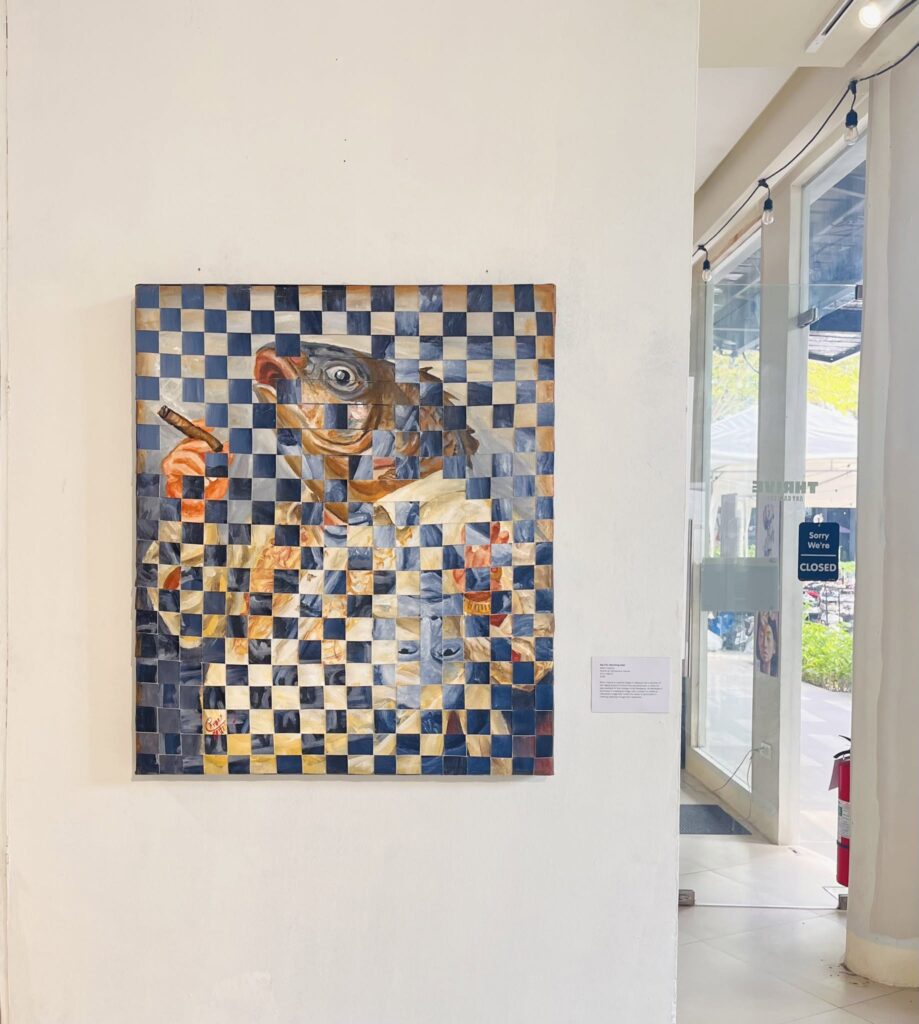
Take Mann Cayona’s ‘Big Fish’ as an example. Two images are literally interwoven in the visual space: a piscine figure, seemingly gasping for air, is juxtaposed with a barong-clad human figure, while a secondary portrait is intermeshed with them, its upturned head bizarrely visible in the frame’s right foreground. A closer scrutiny of the work reveals curious details. A cigar is clenched between the anthropomorph’s digits, its barong is richly embroidered with gold filigree, the warm colors inundating throughout. In contrast, the inverted portrait (an uncanny representation of local heroine Teresa Magbanua?) is steeped in cooler blues and cerulean. Left to the viewer’s gaze, we are invited to ‘make sense’ of the intermeshing and to find coherence in each artwork and in the combination of the two. Delving further, one is compelled to peruse and contemplate between the metaphor and the portrait: what exactly is the ‘big fish’ in the artwork? While one may offer political or literary readings – or altogether dispense with interpreting the work, the visual quality of its parts nonetheless attracts the audience to examine its construction, extrapolating meanings out of it in the process.
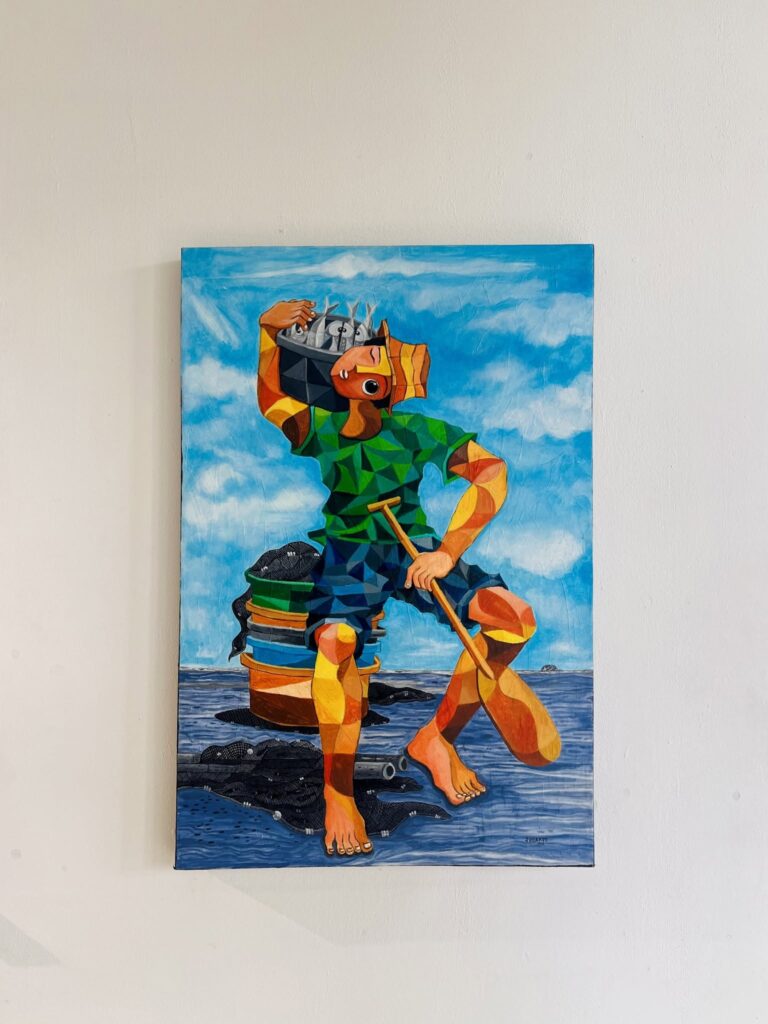
This summation of parts to exceed the whole finds further elaboration in the successive variations of anatomical imagery in the display. Kristoffer Brasileño’s ‘Dagsa’ exemplifies the classic portrait: a Filipina, recognizable by her bronzed features and the bright patterns of her habiliments, balances a palayok of fish and greens on her head, a blazing sky and sea further emphasizing her profile. Here is the whole of the persona, complemented by the materiality of her environs. There is little interaction between subject and background; the former is oblivious to the vibrance behind her. Conversely, her gaze is directed to some distracted distance as if to stolidly persuade her audience to muse with her.
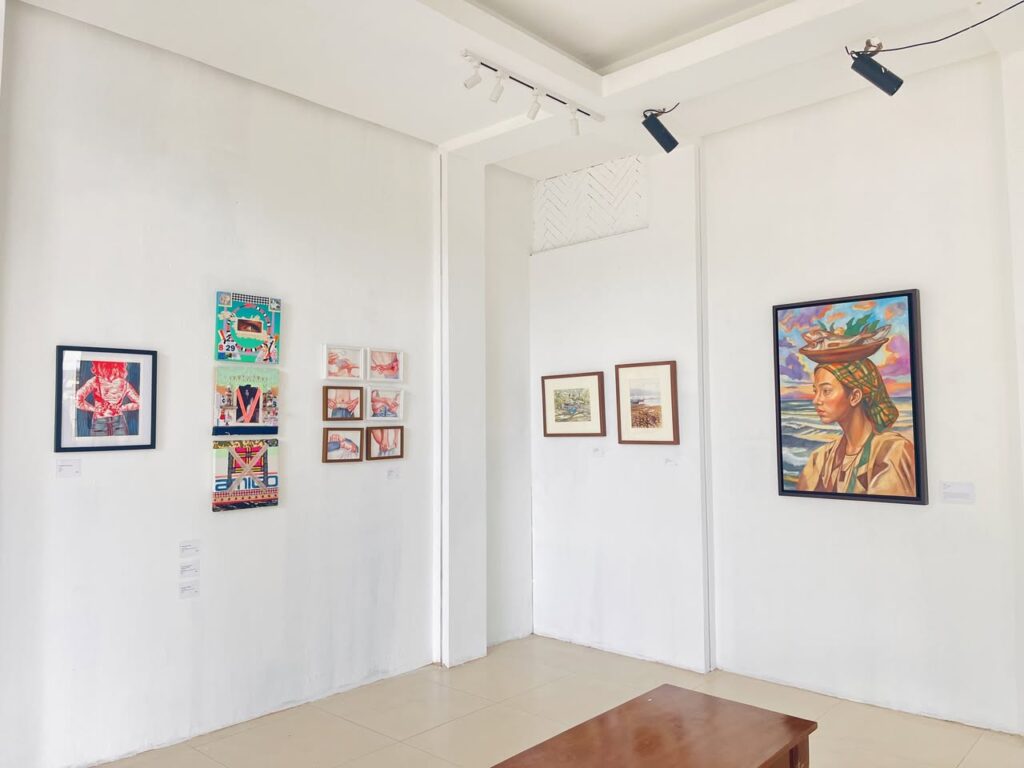
We move to another part of the gallery where we are confronted with deconstructions: Yanni Ysabel’s vignettes of the female form in various stages of deshabille. ‘Trade-in of the Loving Machine’ is comprised of six separate frames, each one focusing on a particular act of undress. Fleeting motions are implied in the fleeting glimpses of skin, cloth, and underwear – only these, and yet one arrives to a coherent understanding of a narrative of intimate and carnal acts. As if to further break down the corporeality of parts, one encounters Noel Elicana’s ‘Dugo at Ugat’, where the visceral aspects of human anatomy are interspersed in rootlike figurations, further probing into the exhibit’s examination of part-whole relationships while underlining propositions of identity and affiliation.
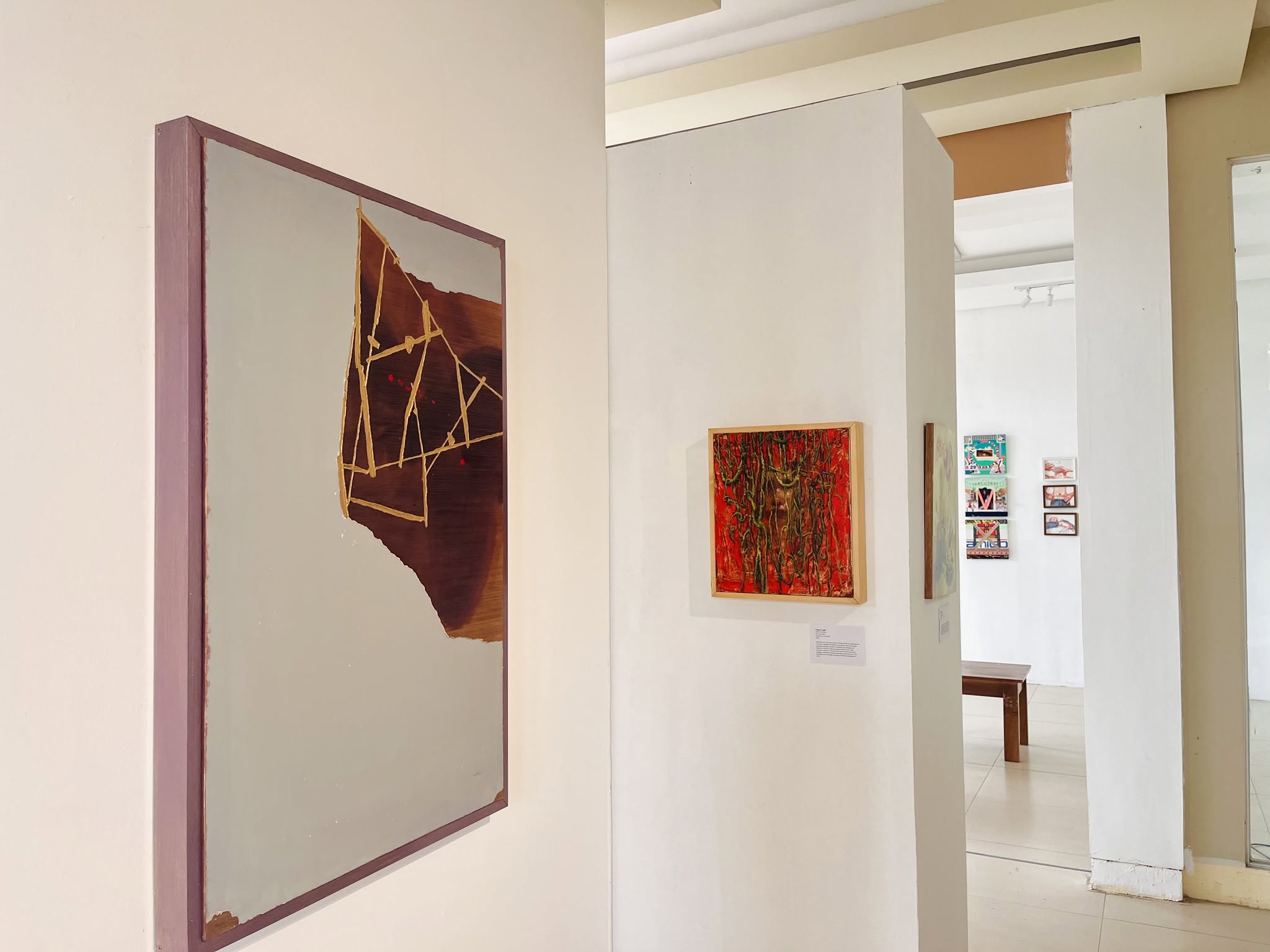
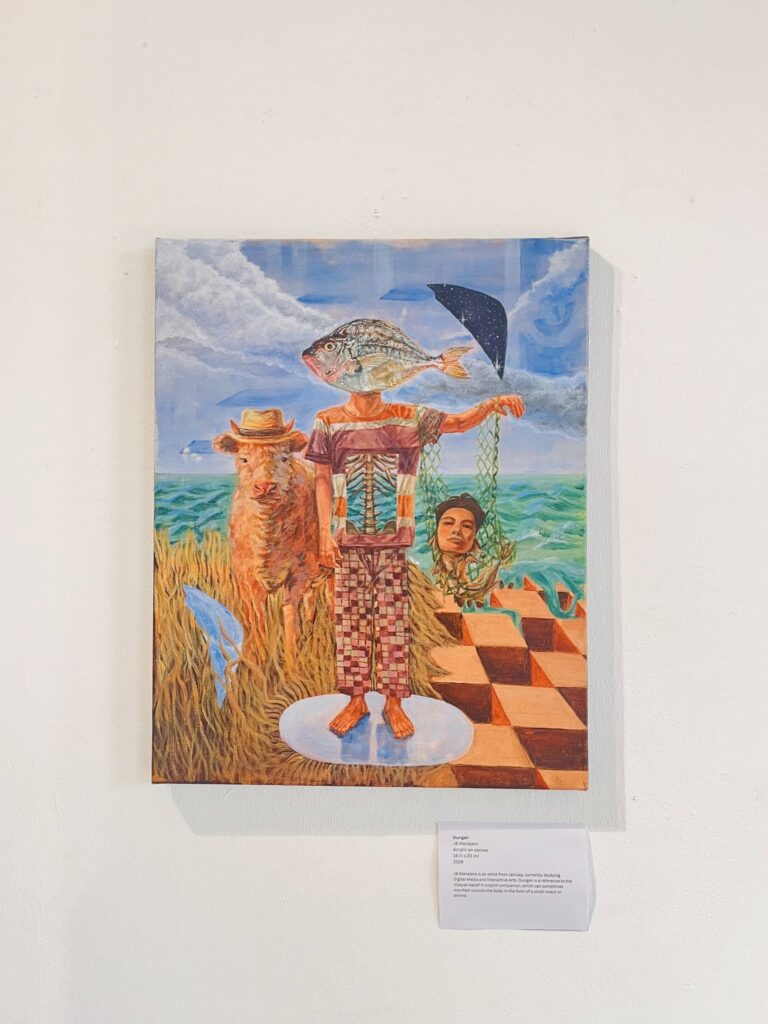
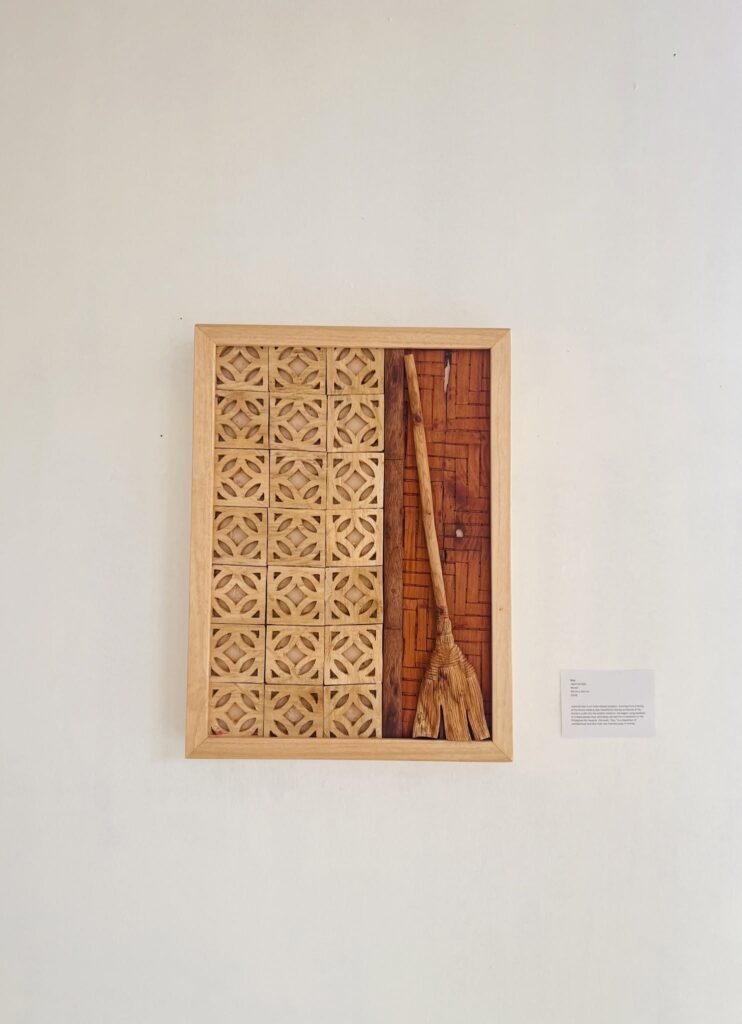
This breaking down of wholes and reconstructions of ideas through figments and fragments of imagery recur throughout the gallery. It is seen in Allain Hablo’s geometric minimalisms of lines and colors, and the hodgepodge assemblage of Margaux Blas. One senses it in Jeanroll Ejar’s sculpted latticework and in Diane Almuenda’s sketchbook, brimming with eclectic vibrance (the bound volume becoming a material space ensuring a semblance of unity amid the eclecticism). It is pondered in the cubist distortions of Jonarde Villarde and the surreal arrangements of JB Manajero and Jonathan Bunker.
A narrative segue and a red herring of sorts: in 2019, I attended a teachers’ symposium at the Ateneo de Manila. Part of the itinerary was a performance of Ang Mga Huling Araw ni Sokrates, where at the conclusion of the play, Ateneo instructor and thespian Ron Capinding recited his doggerel verse about the succulence of a doughnut and the existential significance of its hole. Read for yourself:
Huwag mong hanapin sa butas ng donat ang sarap.
Kailangang may butas ang donat upang maging donat
Dahil kung walang butas, hindi donat.
Ngunit wala sa butas ng donat ang sarap.
Ang do sa gitna ay inalis upang magawa ang ibang donat.
Ang sarap ng butas na iyong hinahanap ay nasa ibang donat.
Kaya’t masarap ang donat kahit may butas ang donat
Dahil ang tunay na donat ay may butas na donat.
Ngunit huwag mong hanapin sa butas ng donat ang sarap.
The audience guffawed at the vivid depiction of the pastry. Yet for all its gastronomic allures and saucy double entendres, Capinding proceeded to explain the metaphor of the doughnut’s hole: the absence of material in reference to the human condition. One may always search for the missing parts that make something significant, albeit an exercise of futility or otherwise, an opportunity for existential epiphanies. Understandably, the same missing parts may be found in other entities, contributing to the idea that wholeness lies more in perceiving the magnitude of the sum of parts rather than the bland totality of a singularity.
In that respect, the anatomy of wholeness – our humanity included – entails the recognition of its ‘hole-ness’: the flawed and the absent, the shattered and the removed, the gaps and the spaces. Innately, we fill in the blanks. Coming full circle to Thrive Art Gallery’s latest exhibit, the same filling in bridges the interstices, liminalities, and limbos among the artworks. Our gazes search for these bridges: we constellate between the lines and the colors, between the metaphors and the meanings.
References:
Arnheim, Rudolf. “Gestalt and Art.” The Journal of Aesthetics and Art Criticism 2,8 (1943): 71-75
Behrens, Roy R. “Art, Design and Gestalt Theory.” LEONARDO 31,4 (1998): 299-306
Photos by:
Daris Gonzales