
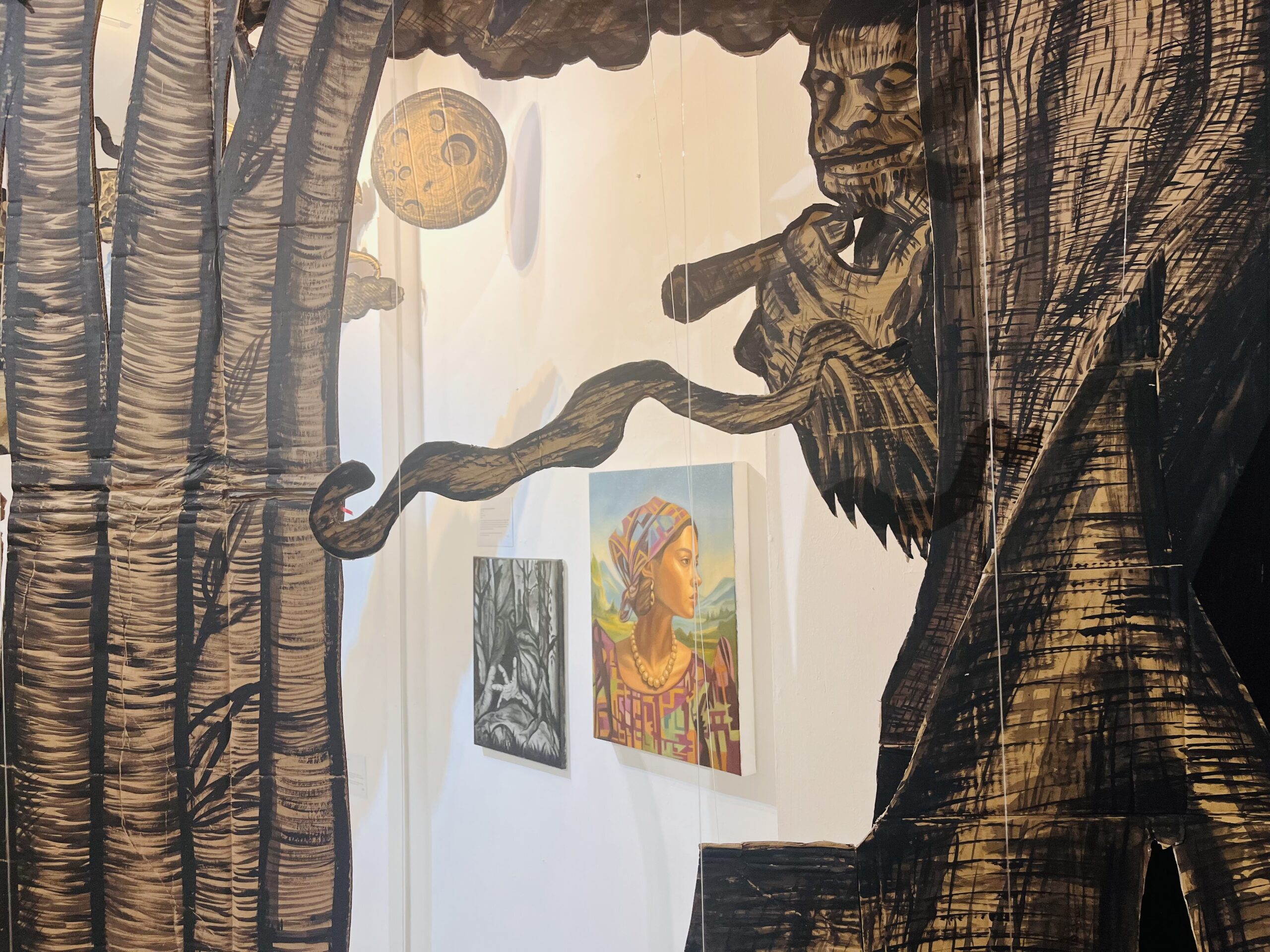
One subject of endless curiosity from our audience, especially those who visit the gallery, is our curatorial process. After 21 exhibitions since Thrive Art Gallery opened in 2023, we finally worked up the courage to reflect and share how we organize and mount our exhibitions in the hopes of fostering curatorial practice within our team and with the artists we collaborate with.
From the beginning, one of Thrive Art Projects’ goals is to supplement art research and education in Western Visayas. When the gallery opened, it was envisioned as a hybrid of a traditional white cube and an artist-led space. As expected in an environment where art appreciation has yet to flourish, there is a constant push and pull between commercial viability and critical research. Do we mount a conceptual exhibition? Do we curate as a collective? Do we want the exhibition to cover the cost of its preparation and eventual implementation? We asked ourselves so many questions, but what we were sure of was that, in every undertaking by Thrive Art Projects, much of what we do is guided by core themes: memory, place, and identity.
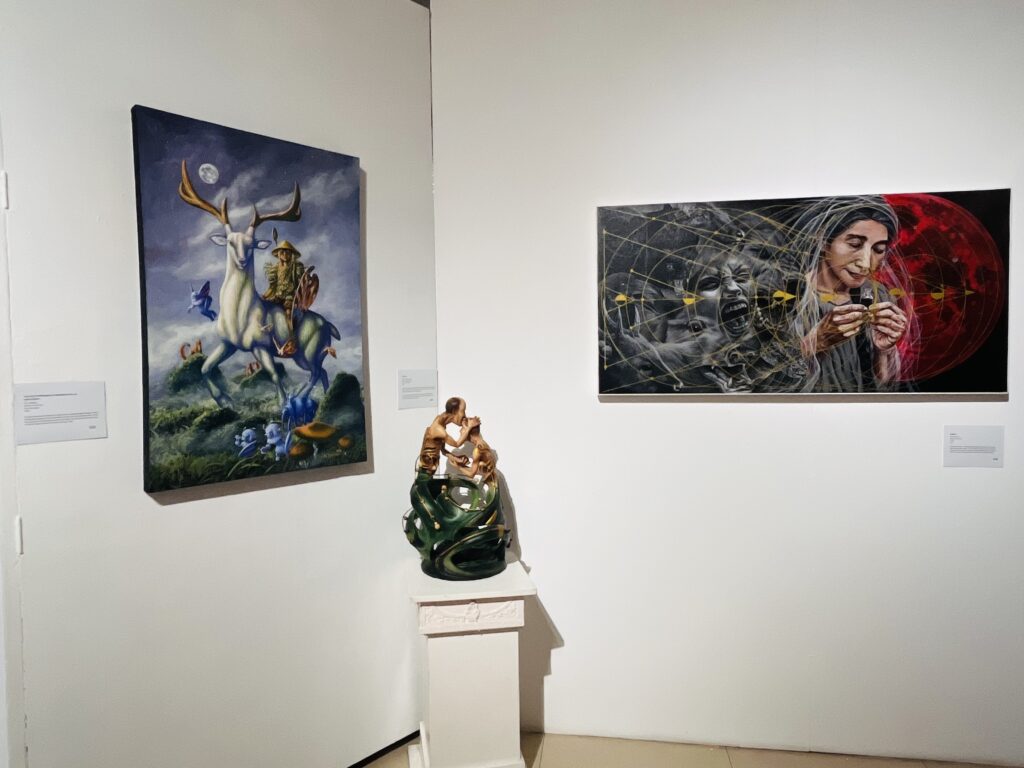
Our current exhibition, “Ambahanon sang Balod kag Kiay sang Kagulangan/Songs of the Waves and Dances of the Woods,” serves as an offshoot of our previous projects, “Tayog-Tayog: The Ilonggo Imagination” and “There is A Story Here, Somewhere.” The advantage of having specific conceptual themes as anchors is that exhibition ideas flow naturally. It allows the space to shape its own identity in relation to its local environment—contributing, in our own small way, to the ongoing definition of what contemporary Ilonggo art can be. In its simplest form, this exhibition encourages the artists to visualize the stories they heard at home, in schools, and in their communities.
The first artists identified for this exhibition were Rolando Manuel Jucar, who impressed us with his resin sculpture in “Tayog-Tayog: The Ilonggo Imagination“; Jzy Tilos whose mariit series depicted, and to some degrees, parodied the Visayan belief in supernatural guardians; Mia Reyes who was awarded a Cultural Center of the Philippines grant for her graphic novel Tulogmatian (based on Jocano’s recoridng of Hinilawod), Katelyn Miñoso whose impressionist takes on the environment contrasts well with the more figurative takes from her fellow artists; and Paul John Cabanalan whose award-winning painting, a perfect mapping of the environment he was embedded in, provides the viewers a birds eyeview of what the exhibition is about. The artists were chosen primarily for the clear parallels between their practice and the exhibition’s themes. We chose the art first, then the artists.
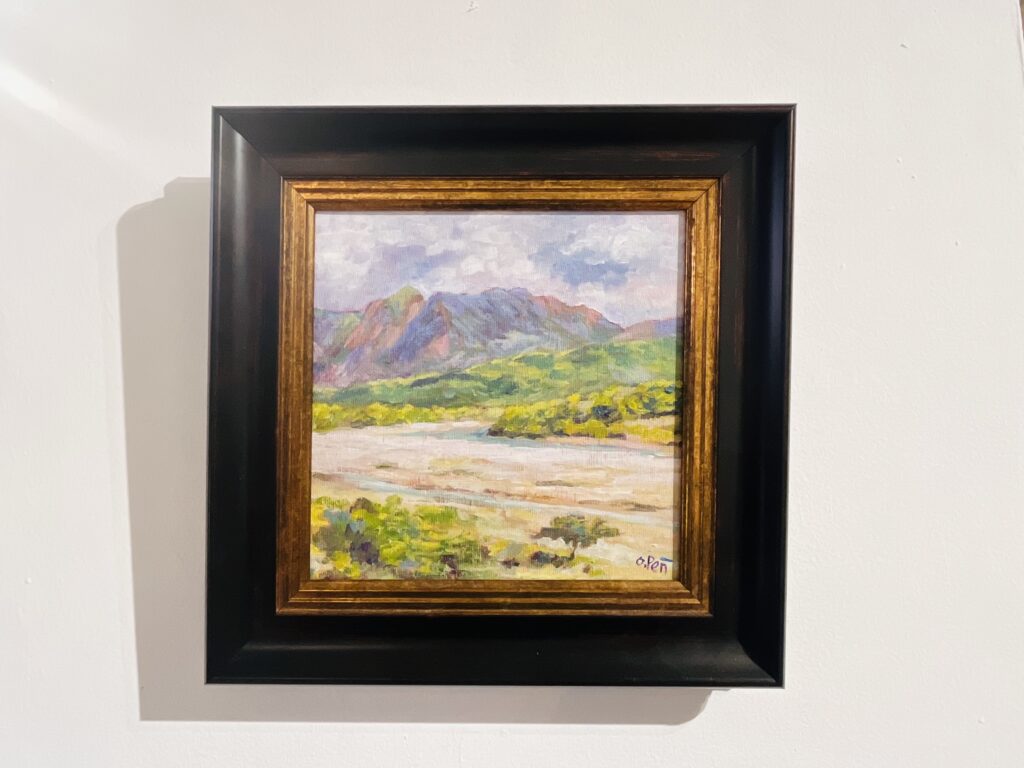
After a short discussion about the title, we settled on “Ambahanon sang Balod kag Kiay sang Kagulangan,” which is inspired by the cultural mapping project “Sa Kabukiran kag Kadagatan/From Ridge to Reef“. With the chosen title explicitly referencing the word song (ambahanon), we knew we needed an immersive sound installation. We invited Prof. Jose Taton Jr., who has been conducting field research on traditional instruments in the hinterlands of Panay. He submitted field recordings that juxtaposed the natural soundscape of cicadas with the litgit (a traditional two-stringed bowed instrument), recorded on location in Valderrama, among other locations in Panay and Guimaras. The recording led us to another painting, Oscar Peñasales’ acrylic painting, “Somewhere in Valderrama,” created after his own visit to the mountain municipality. He had previously entrusted me with this piece after learning I spent part of my childhood there. By pure serendipity, the painting depicts the land my grandfather once owned—land that was eventually erased by the raging Cangaranan River during typhoon season.
To cover the multi-layered narratives across Panay, we continued expanding the lineup. El Dosado, whose work explores fantastical realms, submitted a painting of a deer—a creature frequently cast as a mystical guardian of the forest in Panay mythology. Noel Galon de Leon joined with collages that resemble the ebb and flow of time, merging disparate places and stories into singular images, kind of what the exhibition is trying to achieve. To tie the visual narrative together, Sinag Buhat—a newly formed collective—brought their background in production design into the gallery. The group created an installation rendering the drawings as quick and raw sketches, and using the organic texture of used cardboard boxes to bring Panay folklore figures like the bakunawa, kataw, and duwende to an immersive page in a children’s book.
“Ambahanon sang Balod kag Kiay sang Kagulangan” is our fourth exhibition this year after shifting to a two-month duration. We learned that longer exhibitions allow us more time to gather artists’ portfolios, research the themes, and create a dialogue with our audience. Perhaps the simplest summary of our process is knowing our art world and creating a bridge from that art world to the general audience.