
I’ve always found nonfiction books easier to read than any other genre of literature. There is a distinct, grounding comfort in knowing that the words on the page are tethered to real life, real consequences, and real human hearts. When the narrative hits the right chord, I can sit down with a book at page one and not stand up until I’ve finished the very last page.
Some of the authors I look up to most are Joan Didion, Nora Ephron, and Eve Babitz—who, in retrospect, are all brilliant women writing about their complex, glittering, and sometimes devastating lives in America. Through these writers’ view, a place becomes a backdrop for something much larger. Perhaps nonfiction, at its finest, is one of the great ways to discover the universality of human experiences. In its most honest form, it can prove that grief, wit, and ambition could feel the same for everyone, no matter where they come from.
This appreciation for nonfiction writing is not confined to international literary icons, of course. Closer to home, some of the West Visayan writers whose essays I find deeply entertaining and insightful are Dulce Deriada, Gen Asenjo, and the wonderfully colorful Peter Nery. These regional voices carry a specific tone—a blend of sensibility and cultural heritage that speaks directly to the Western Visayan soul. Their works capture the nuances of our everyday realities and are proof that the local is not only vital but also universal.
Because of this fondness for nonfiction, it brought me excitement when a friend of the gallery gifted me a book that led me to the discovery of another woman writer living in Iloilo. For some readers, a book comes to them in entirely serendipitous ways, arriving at an exact moment when it almost feels like the universe has timed it. This memoir caught me at my own personal crossroads, somewhat of an intersection of uncertainty brought about by the passage of time. But this essay is not about my own crossroads; it is about how a single life story can perhaps serve as a lantern for others who are trying to find their way out of the dark.
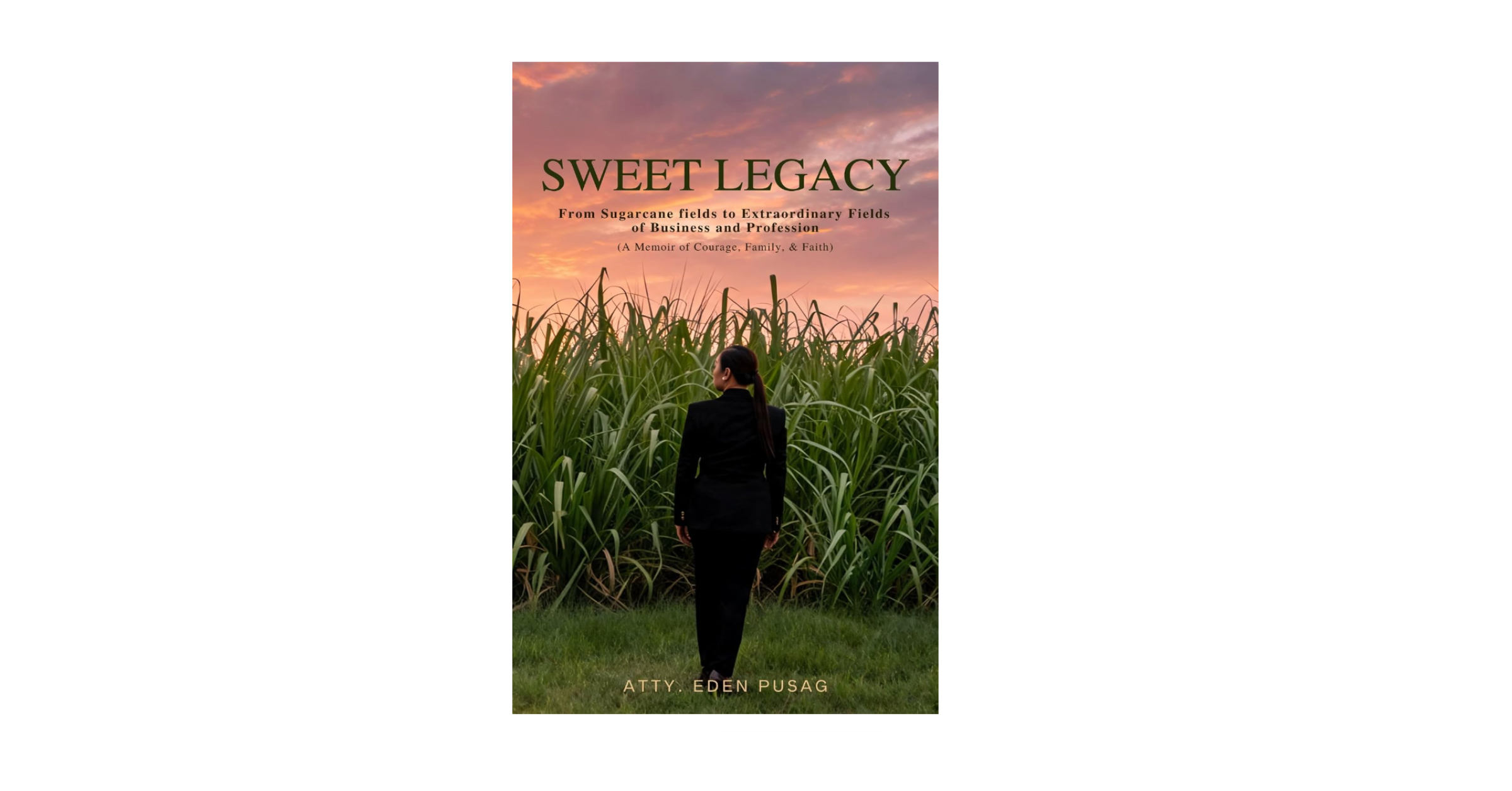
Sweet Legacy: From Sugarcane Fields to Extraordinary Fields of Business and Profession is a memoir written by Atty. Eden Pusag. The author narrates her humble beginnings in the sugarcane fields of rural Batangas, her grueling struggle for survival and education in the concrete expanse of Manila, and eventually her hard-won success in her legal and business profession. What the book did not promise were quick fixes and superficial triumphs. It offered profound honesty. It does not preach, it does not pretend, and, most of all, it does not prescribe a formula for how to live your life.
Atty. Pusag simply takes the reader for a ride on the rollercoaster that is her life, sprinkling lovely, evocative prose along the way. She does not sugarcoat the steep drops or the dizzying loops of her journey, which included working as a service crew at a popular donut store, earning commissions as an Avon lady, and manning a hotel’s front desk. The reader learns not by being lectured, but simply by listening to her stories page by page, witnessing the quiet dignity with which she faced adversity.
Divided into the different chapters of Atty. Pusag’s life, the book is composed of essays that are remarkably easy to digest. They are short, making them accessible to a reader who needs to juggle many things with such a limited schedule. But this did not mean that they are not heavy with the immense weight of success and the profound responsibility to share the path so that others may forge their own.

In the essays that Atty. Pusag penned, there are reminders that success is empty if it is kept entirely to oneself. She talks about sharing apartments with her family and often about her daughter. The “sweet legacy” of the title is not just the wealth or status accumulated at the end of a career; it is the wisdom harvested that is shared back into the community.
In my work, I have been contemplating the notion that whatever stories we choose to document, preserve, and celebrate—whether through literature or visual art—may in the future be the anchors of our collective memory. And here is Atty. Pusag, who documented her story, as her own contribution.
I guess this is why nonfiction remains a preferred sanctuary for many readers. While fiction allows us to escape the world, nonfiction encourages us to look closer, engage deeper, and find meaning in the actual lives lived around us. Atty. Pusag’s memoir is a testament to the importance of writing down our memories. Once finished, this book leaves the reader with a lingering question that may follow them long after the back cover is closed: What legacy are we building with the raw materials of our own lives? For anyone currently standing at their own crossroads, wondering if the struggle is worth the destination, this book could offer a resounding, beautifully written affirmation.