
I DID NOT EXPECT that the most important artworks in Art for Everyone 2026 would be the ones without labels. That realization did not arrive immediately. Like many visitors, I entered the annual exhibition inside a private shopping mall in Iloilo City expecting to encounter an impressive survey of local artistic talent. I anticipated walls overflowing with technical virtuosity, meticulous realism, vibrant abstractions, carefully balanced compositions, and visually seductive works eager to demonstrate the extraordinary skills of Iloilo’s artists.
There was certainly no shortage of beautiful paintings. Everywhere I looked, canvases celebrated color, texture, craftsmanship, and aesthetic harmony. Many deserved admirations for the discipline evident in their execution. Yet after moving from one artwork to another, I found myself repeatedly returning to two objects that seemed almost indifferent to conventional beauty. They were rough. They were unsettling. They were materially unconventional. They appeared to reject the very expectations that most visitors bring into an exhibition. More importantly, they possessed something that many technically accomplished works unfortunately lacked. They had something urgent to say.
Among an exhibition crowded with artworks primarily concerned with aesthetic achievement, Guijo Dueñas demonstrated a far deeper understanding of artistic engagement. His works were not asking merely to be admired. They demanded to be questioned, argued with, and remembered. Long after countless beautiful paintings had begun to merge into one another, these two unlabeled textile works continued occupying my thoughts.
Ironically, they were also the only works that refused one of the most fundamental conventions of exhibition practice. They had no labels. No title cards. No list of materials. No dimensions. No artist’s statement. Nothing identified them except the works themselves. Curious, I asked one of the exhibition attendants why these pieces alone remained anonymous. The answer was surprisingly simple. According to the attendant, the artist himself did not want labels attached to his works.
At first, this decision might seem eccentric, perhaps even unnecessarily difficult for audiences accustomed to institutional guidance. Yet the longer I stood before the works, the more I realized that the absence of labels was not a rejection of exhibition protocol. It was the first conceptual gesture of the artwork itself. Labels often perform an invisible authority inside galleries. They reassure us that we are looking at something important. They identify authorship, medium, date, and occasionally provide a paragraph that quietly instructs us how to interpret what we see. Labels frequently function as permission slips for understanding. By removing them entirely, Dueñas refuses institutional mediation. He asks viewers to confront the work before confronting the artist. He insists that meaning should emerge from encounter rather than explanation. In doing so, he transfers interpretive responsibility back to the audience. The absence of labels is therefore not an omission. It is the beginning of the artwork.
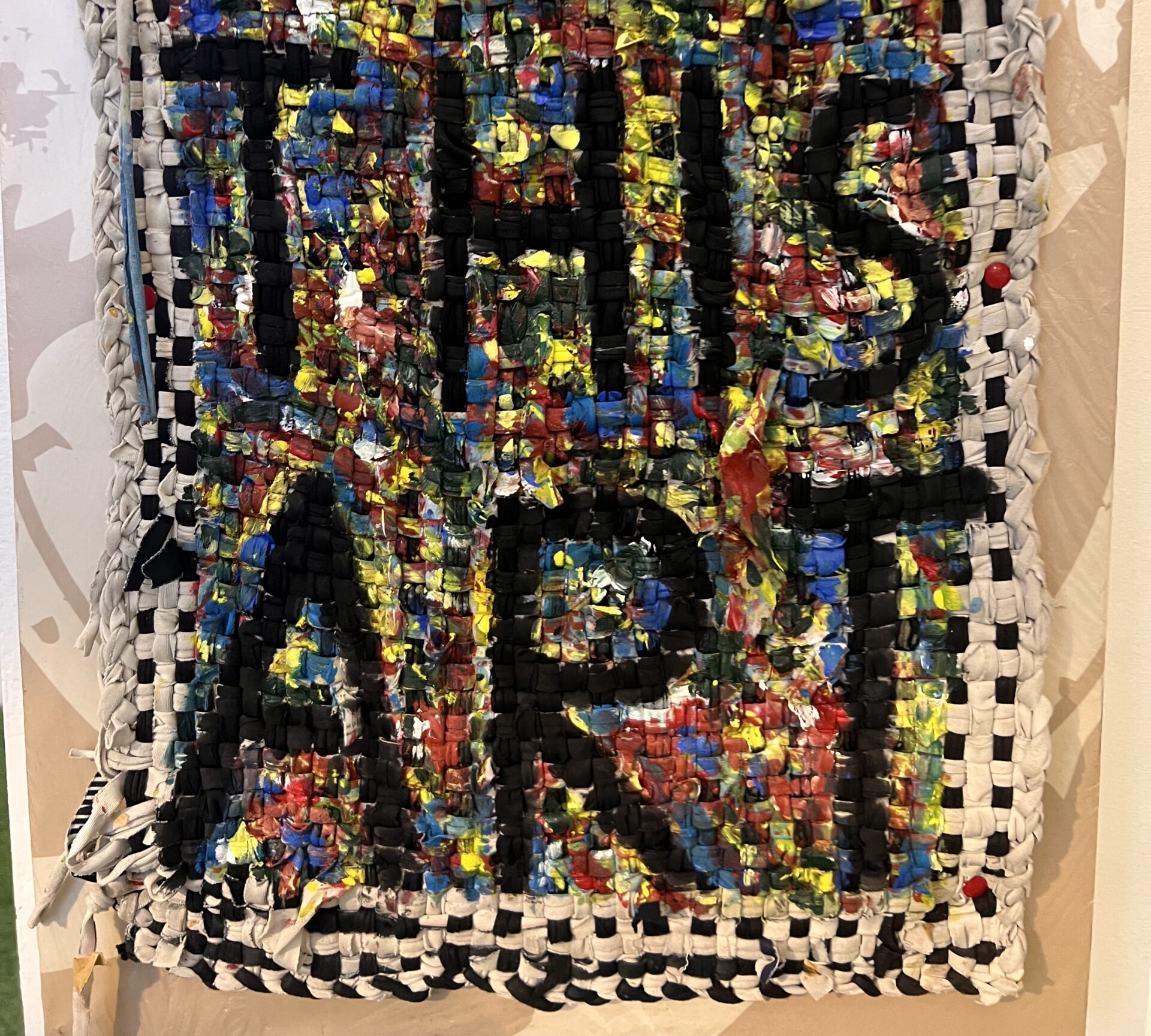
The first piece appears to be an oversized woven rug constructed from braided strips of black and white fabric. It resembles something handcrafted, domestic, familiar, almost ordinary. Yet whatever sense of familiarity one initially experiences is immediately disrupted by an explosion of thick acrylic paint violently accumulated across its surface. Blue collides with yellow. Red bleeds into green. White interrupts black. Layers of pigment sit heavily upon the textile, refusing smoothness and elegance. The paint is not delicately brushed. It is pushed, scraped, pressed, and accumulated until it behaves almost like another textile woven into the object itself. The materiality of paint becomes physical rather than merely optical. Hidden beneath this dense accumulation of color, only gradually revealing itself through patient looking, are three words that fundamentally alter the viewer’s experience.
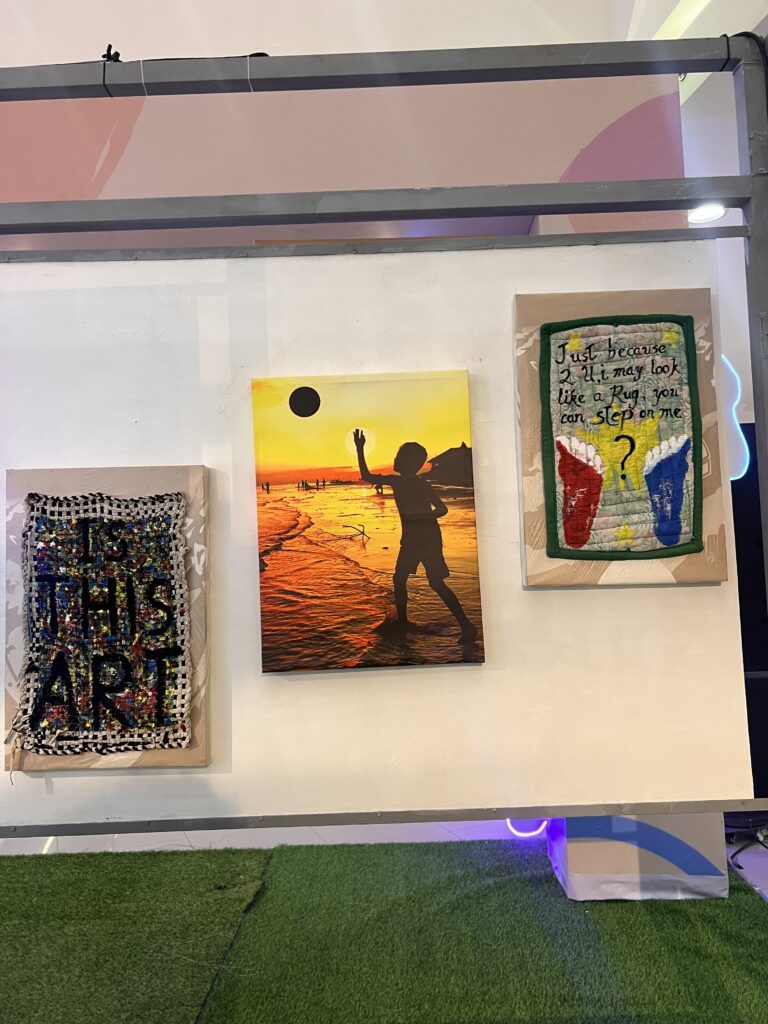
IS THIS ART
Few questions have haunted the history of art more persistently than those three words. Yet Dueñas refuses to answer them. He does not proclaim that the object before us is art. He does not defend its legitimacy through explanation or theory. Instead, he quietly returns the question to us. The work refuses certainty. It transforms spectators into participants by forcing each viewer to examine the assumptions they carried into the exhibition.
What exactly qualifies something as art? Is it technical mastery? Is it beauty? Is it originality? Is it institutional recognition? Does something become art because it hangs inside an exhibition rather than lying on the floor of an ordinary household? Does the gallery produce artistic legitimacy? Does authorship alone elevate an object? Or does art emerge from its ability to provoke reflection, disrupt habit, generate conversation, and transform ordinary materials into extraordinary intellectual experiences? These are questions philosophers, critics, artists, and historians have debated for centuries. Remarkably, Dueñas condenses that enormous discourse into three ordinary words woven into one ordinary household object.
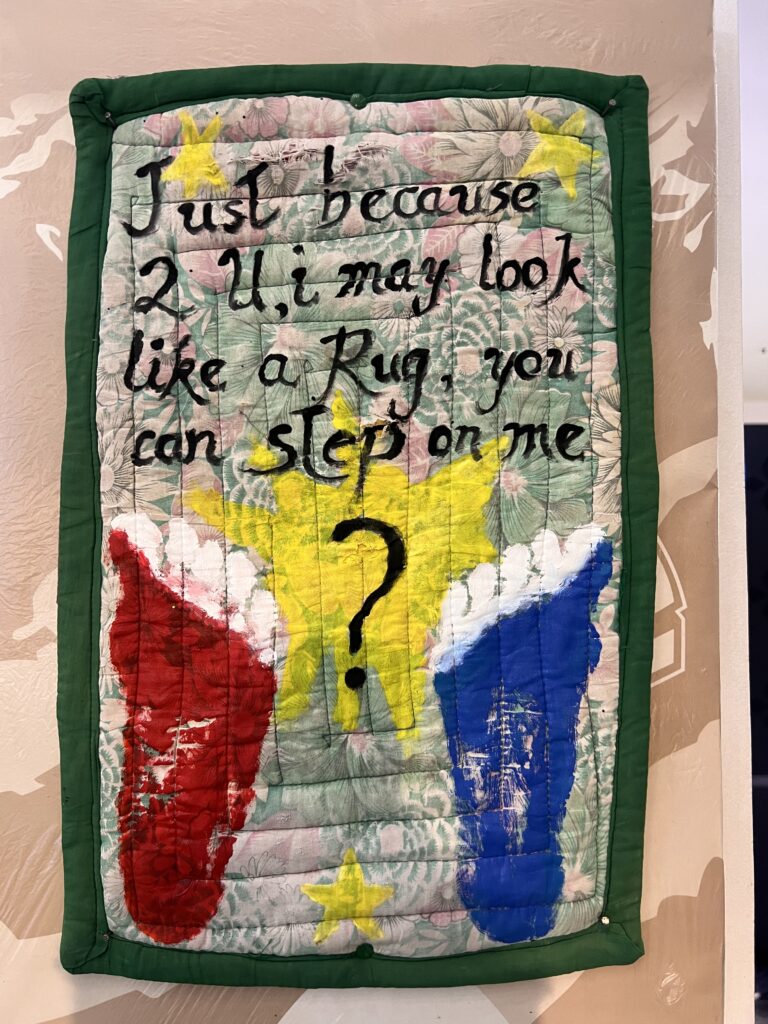
The second work appears at first to be even simpler. It resembles a quilted rug bordered with green fabric. Painted upon its surface in loose handwritten script is a sentence that is at once accusatory and painfully vulnerable: “Just because 2 U, I may look like a rug, you can step on me?” Below the text are expressive references to the Philippine flag through simplified fields of red, blue, yellow, and white. A large question mark dominates the center of the composition. Again, the object speaks. Or perhaps it protests. Or perhaps it mourns. The remarkable achievement of the work lies in its ability to make an ordinary household object articulate an experience of humiliation, exploitation, and disregard. A rug exists to be stepped upon. It absorbs dirt without complaint. It remains beneath everyone. It performs necessary labor while remaining almost entirely invisible. By allowing the rug to speak, Dueñas transforms an object of domestic utility into a metaphor for artists, workers, citizens, and perhaps even the nation itself.
The brilliance of both works lies in Dueñas’s understanding that medium is not separate from meaning. These ideas could never have been communicated as effectively on stretched canvas. Had he chosen conventional painting surfaces, much of their conceptual force would have disappeared. The rug is not merely a support for paint. It is the artwork’s language. Its domestic associations, its working-class familiarity, its function as an object designed to endure footsteps all become inseparable from the ideas the works communicate. Material here is argument. Form becomes philosophy. One cannot separate what the work says from what the work is made of. That is precisely where contemporary art distinguishes itself from decorative production. Every artistic decision carries conceptual weight.
Some viewers may inevitably ask whether these objects can genuinely be considered art. Ironically, that question is precisely what proves their artistic significance. Throughout much of history, art was defined through representation, beauty, proportion, craftsmanship, permanence, and technical mastery. Those values remain important, but they no longer exhaust the possibilities of artistic practice.
Twentieth-century art fundamentally transformed our understanding of what art could become. Artists challenged the authority of traditional media, elevated ordinary objects into artistic discourse, questioned institutional definitions, and shifted attention from visual pleasure toward conceptual inquiry. Contemporary art no longer asks only whether something is beautiful. It asks whether something thinks. Whether it challenges. Whether it expands perception. Whether it creates new conversations about the world we inhabit. Dueñas stands firmly within that intellectual tradition, but he does so without abandoning local realities. His materials emerge from ordinary Filipino households rather than elite artistic traditions. His language remains accessible. His metaphors belong to everyday life. Yet beneath that accessibility lies remarkable conceptual sophistication.
What fascinated me most was not only the intelligence of these works but the extraordinary courage required to exhibit them in the environment where they now exist. This is not a museum dedicated to critical inquiry. This is not an independent contemporary art space known for political experimentation. This exhibition takes place inside a private shopping mall, perhaps the most recognizable architecture of consumer capitalism. Every hallway, every storefront, every display window ultimately encourages consumption. Art exhibitions inside malls frequently become extensions of commercial experience. Paintings soften architecture. Sculptures beautify public spaces. Cultural events generate foot traffic. Art becomes another attraction within an economy of consumption. There is always the danger that artworks become decorative accessories rather than intellectual interventions. Against this backdrop, Dueñas refuses to participate quietly. Rather than decorating commerce, he interrogates it. Rather than providing visual comfort, he introduces conceptual discomfort. That decision deserves recognition.
The second rug becomes particularly devastating when viewed through this context. “Just because 2 U, I may look like a rug, you can step on me?” The question extends far beyond the object itself. Who exactly is speaking? Is it the rug? Is it the artist? Is it art? Is it every cultural worker expected to remain grateful simply because they have been granted visibility? The work inevitably recalls the precarious conditions under which many artists continue to labor. Exposure has increasingly replaced compensation. Visibility substitutes for structural support. Artists are repeatedly told that participation itself constitutes opportunity. Recognition is promised later. Financial sustainability remains uncertain. Meanwhile, institutions continue benefiting from the cultural prestige artists generate. Dueñas transforms that uncomfortable reality into one unforgettable question. The rug ceases to represent domestic labor alone. It becomes a portrait of artistic labor under contemporary capitalism.
Among the many aesthetically accomplished works surrounding Dueñas’s installation, these two pieces distinguished themselves because they were concerned with something larger than visual pleasure. Let me be clear. There is nothing inherently wrong with beautiful art. Beauty remains one of humanity’s most profound experiences. Technical excellence deserves admiration. Composition, color harmony, craftsmanship, and visual elegance continue to matter. Yet beauty alone cannot sustain artistic discourse. When exhibitions become dominated exclusively by aesthetically pleasing objects, viewers eventually move through them passively. One beautiful painting replaces another until individual works begin dissolving into visual repetition. Nothing interrupts the eye. Nothing demands intellectual participation. Nothing risks disagreement. Nothing insists upon deeper reflection. Dueñas understands something that many emerging artists have not yet fully embraced. Art is not obligated merely to satisfy the eye. It possesses the capacity to produce thought, provoke dialogue, complicate assumptions, expose contradictions, and intervene within public life.
This, perhaps, is the lesson that younger artists participating in Art for Everyone 2026 should carry with them long after the exhibition concludes. They should not imitate Dueñas’s visual style. They should not suddenly abandon painting in favor of rugs or conceptual installations. That would entirely miss the point. What deserves imitation is his courage. Technical skill can be acquired through discipline. Materials can be purchased. Composition can be studied. But artistic courage cannot be taught through manuals. It requires intellectual honesty. It requires asking difficult questions even when doing so risks misunderstanding. It requires believing that one’s work can contribute meaningfully to conversations larger than the self. It requires resisting the temptation to produce only what is immediately marketable or socially acceptable. Most importantly, it requires developing an authentic artistic voice that speaks to one’s historical moment.
As I continued walking through the exhibition, I found myself asking questions that every participating artist might also ask themselves before beginning another work. What exactly am I contributing to the cultural conversation of Iloilo? Beyond technical achievement, what ideas am I placing into public discourse? Am I using my artistic practice to examine the realities surrounding my community, or am I merely reproducing familiar images because they are easier to sell, easier to exhibit, and easier to admire? Do I possess my own artistic voice, or have I unconsciously surrendered that voice to market expectations, institutional preferences, social media algorithms, and collector demands? These questions are uncomfortable precisely because they cannot be answered through aesthetics alone.
There is another question that inevitably follows. Are artists unknowingly becoming participants in the continuing exploitation of their own labor? Contemporary capitalism possesses an extraordinary ability to absorb creativity while neutralizing its critical potential. Artists produce cultural value. Institutions gain prestige. Commercial spaces attract audiences. Social media celebrates visibility. Yet the artist frequently remains economically vulnerable. The danger is not merely financial. It is philosophical. When artists become preoccupied exclusively with producing objects that are visually attractive, commercially viable, and immediately consumable, they risk abandoning one of art’s most important historical functions, its ability to question power. They become producers of commodities rather than producers of ideas. The tragedy is that such transformation often occurs gradually, almost invisibly, until exhibitions become filled with beautiful objects that say very little about the societies from which they emerge.
This is why Guijo Dueñas’s contribution to Art for Everyone 2026 matters. His works remind us that artistic practice is not simply about creating beautiful things. It is about constructing meaningful conversations. It is about recognizing that every artwork enters public discourse whether intentionally or not. Silence is also a statement. Decorative neutrality is also a position. Refusing to address social realities is itself a form of engagement with those realities. Dueñas chooses instead to speak directly, courageously, and without apology. He understands that contemporary art can simultaneously serve as criticism, philosophy, public intervention, and civic dialogue.
As I left the exhibition, I realized that these two unlabeled rugs had fundamentally transformed my experience of the entire show. I entered expecting to evaluate paintings according to familiar standards of composition, technical mastery, originality, and beauty. I left thinking instead about artistic responsibility, spectatorship, labor, capitalism, institutional power, and the future direction of Iloilo’s contemporary art. That shift represents the highest achievement any artwork can accomplish. The most enduring works are rarely those that merely impress us in the moment. They are the ones that continue speaking after we have gone home.
Days later, we may forget the exact brushwork of an accomplished landscape or the precise color relationships of an elegant abstraction, but we continue wrestling with a question like “Is This Art?” because it eventually transforms into a far more personal inquiry. What do I expect art to do? Why do I privilege beauty over meaning? What responsibilities do artists owe their communities? What responsibilities do audiences owe artists? What kind of artistic future do we want for Iloilo?
Those questions extend far beyond the walls of a shopping mall. They belong to classrooms, museums, galleries, cultural institutions, universities, and every space where art continues shaping public imagination. Guijo Dueñas reminds us that the future of Iloilo art will not ultimately be determined by those who merely perfect aesthetics. It will be shaped by those courageous enough to use art as language, criticism, and public conscience. In an exhibition overflowing with artists eager to be seen and recognized, his works stood apart because they demanded something far more difficult. They refused simply to decorate a wall. They insisted on beginning a conversation. And perhaps that is the greatest contribution any artist can make, not merely to an exhibition, but to the cultural future of a community.
Before asking whether a work will sell, receive awards, accumulate likes, or attract collectors, every artist participating in exhibitions like Art for Everyone might first pause before Dueñas’s woven question and ask themselves with complete honesty: Is this art? The answer, ultimately, does not reside in the rug. It resides in the depth of thought, courage, integrity, and public engagement that every artist is willing to weave into the work they leave behind.