
Do not go gentle into the good night
Rage, rage against the dying of the light.
— Dylan Thomas
There was a time when Robin Yankin raged against the dying of the light.
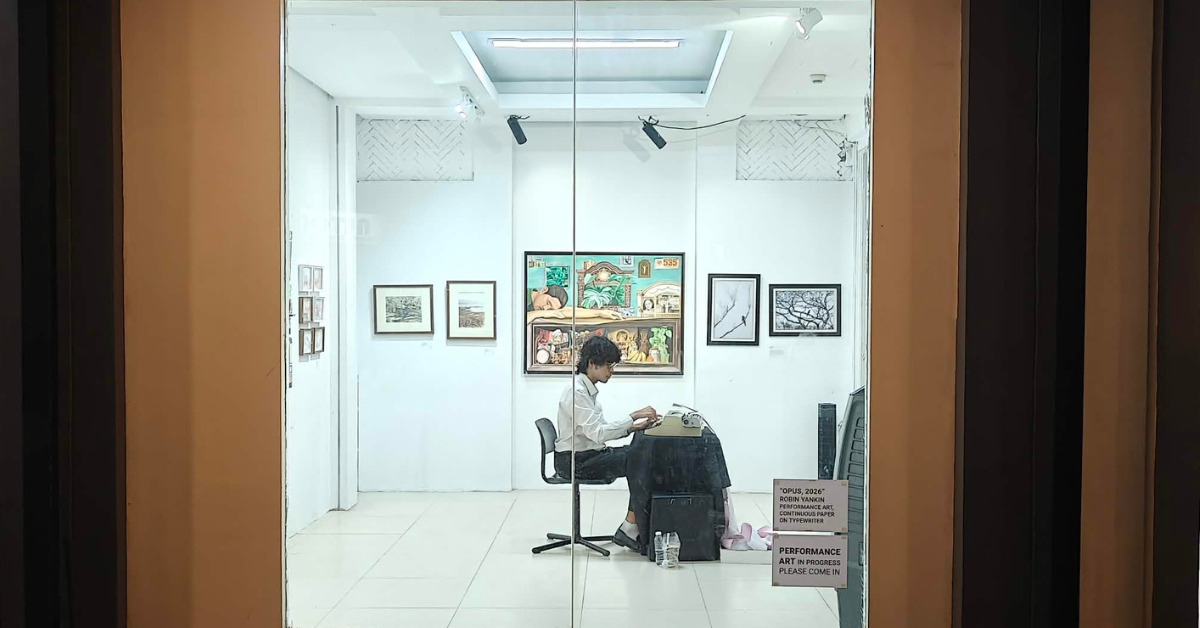
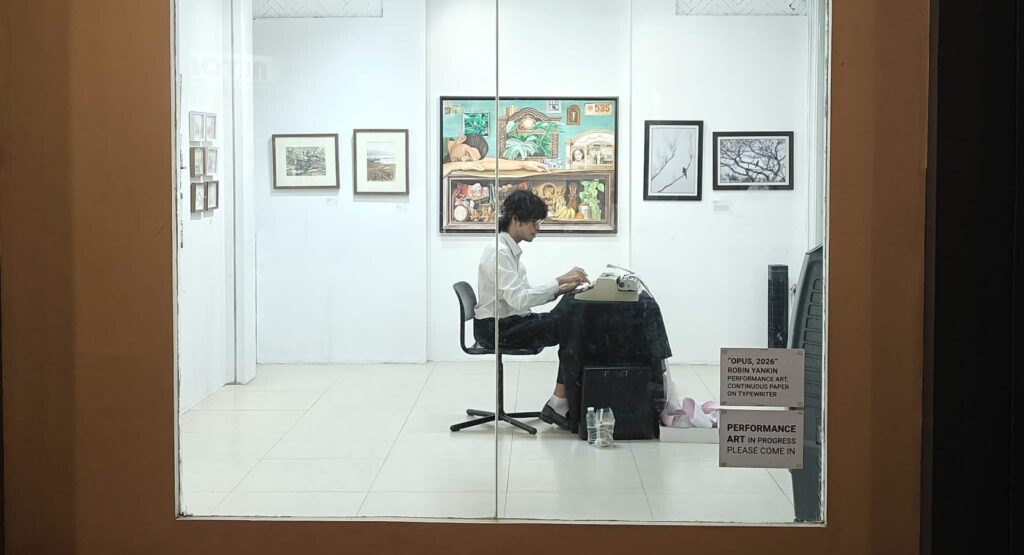
Afternoon of June 23: he was in Thrive Art Gallery, surrounded by frames of artworks. In that backdrop of expression, he proceeded to type his heart and soul out in an obsolete writing mechanism, pouring out a rambling narrative defying the callous impersonality of AI aspiring to write and versify as if it was soul-gifted man. In that stubborn resolve to squeeze out a story in one prolonged sitting, the writer was raging against the machine.
The man behind the typewriter was Robin Yankin: litterateur, critic, commentator, and weaver of verses. He brazenly sat through the hours, unmoved and unfazed by the mingling clumps of curious onlookers and well-wishers perusing the gallery’s art or the torrent of words that mechanically appear on the thin skin of the paper. His bent form typed away obliviously, pouring out words and whimsies as if the hour is apocalypse now.
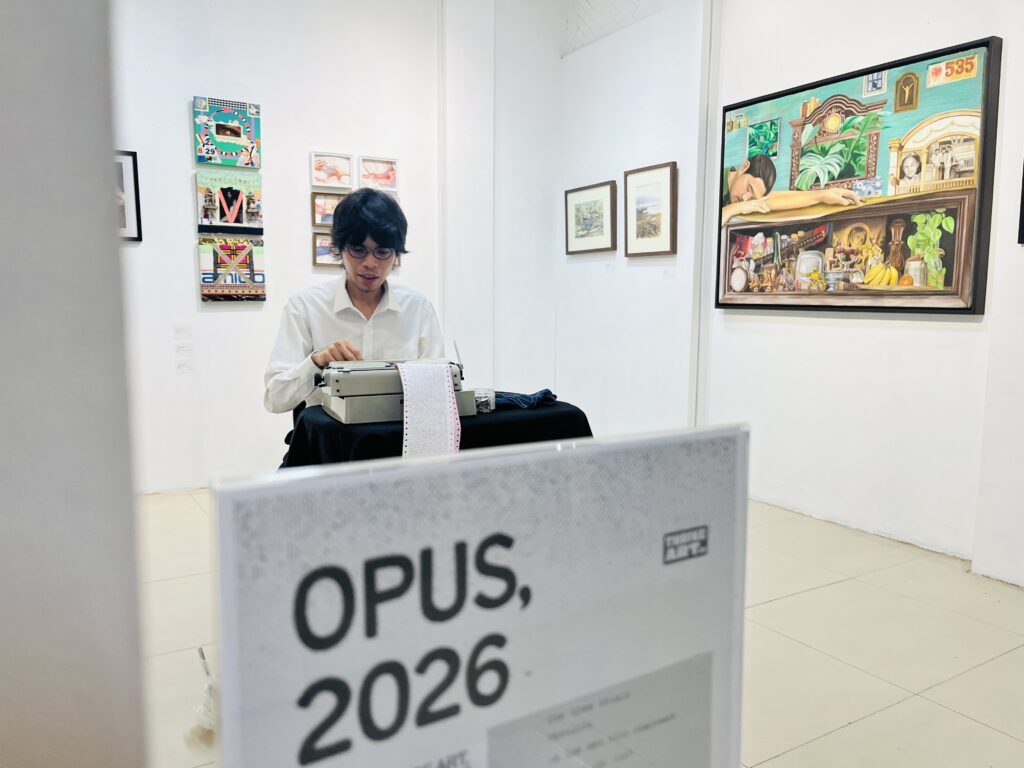
Dusk has fallen when truly yours dropped by the gallery. The writing has been unfolding already for several hours and one can see the unending strip of a ream of white and pink receipt paper drawn up and digested by the aperture of his Adler Gabriele 10 like some ammunition belt expended in sporadic albeit incessant bursts of literary outflow. The rattling of the typewriter keys endowed it with a sense of intellectual audibility: the free-flowing clicking and clacking becomes the syncopated rhythm of his prose.
It was around 7:30 when he finally hit the last key. With a definitive click, he punctuated the opus with a momentary finality. The prose — or was it poetry? — ended with a comma, tying the chopped clause back to the first word at the top of the page, looping the narrative in a linguistic Möbius strip that defied the literary conventions of beginnings and ends, of rising actions and resolutions. It scrambled flashbacks and foreshadowings. It convoluted enjambments with in medias res.
What was the five-hour literary pasyon all about, that exhausting, excruciating churning of ideas into a coherent composition? In the exhibit notes circulated online prior the performance, he explained it with a pointedly unapologetic description of our times:
“We have arrived at a point in late-stage capitalism such that, because of increasing economic instability, mass unemployment, disillusionment, disenfranchisement, and doubts regarding the future of traditional work settings, especially in the wake of artificial intelligence (AI) and large language models (LLMs), more and more people are turning to art in varying degrees as a viable alternative, not only as it informs and reignites their raison d’être but also provides them the unique opportunity to monetize their passion. Ironically, it is these same material realities that provided the backdrop for artists struggling to balance their pursuit of personal aesthetics against practicality, responsibility, and survival: it simultaneously held the potential for success or failure.”
For what it was worth, the performance was Robin Yankin’s raging at the dying of the light. In the clatter and clank of the Adler Gabriele 10 that afternoon, he framed the artist’s labor and genius as besieged by the twists and turns of a world caught up with reckless innovation, impulsive instantaneity, and rabid competitiveness, all at the expense of human depth and creativity. He caught what it was all about, and in that five-hour seating, his narrative beyond that ream of paper was clear: the writer — and all the kindred souls who paint, sketch, sculpt, sing, dance, act, weave — will not go gentle into that good night.
The writer as Everyman
We finally got a chance to peruse what Robin has written in Thrive Art’s recent opening of a new exhibit. The work was hung up the height of a display board, like some verbose snake shedding its skin in a steady stream of consciousness or in an untrammeled train of thought. It was a story; prosaic at most, yet there is poetry tucked in between the lines. At a glance, it was an introspection of tedium, frustration, drudgery, reverie, nostalgia, a bit of vitriol perhaps — a hodgepodge of memories and visions close to the author’s heart.
I was not able to read through that entire serpentine sliver of a story. However, the segments were revealing of sonder-scenes attempting to encapsulate a more or less universal experience of the struggling artist: what is autobiographical to Robin becomes a biography of Everyman gnashing his teeth at the noisome demands of life that curb the creative impulse and dull the soul of its aesthetic impetus. The description is vivid and familiar, as it could be anyone of us:
…He is not quite thirty years old,
still has his whole life ahead of
him, but already he feels that he
is falling behind, why, because
everywhere he looks, other people
have already had life figured out,
or so it would seem, hell, nobody
has their life figured out, not even
after they have crossed forty,
the supposed second puberty…
…he is not quite thirty, he works
at a BPO, the graveyard shift,
data entry, all for bills bills
more bills, all to say that money
is still flowing, although sometimes,
he finds the time to write, about
anything that he finds fascinating,
about the moon
about the stars about life
about death about war
about peace about literature…
Then again, who truly figures out life? The query is a philosophical cliche recurrently brought about by sordid realities, something which both author or reader cannot seem to escape. Take labor, for instance. In Robin’s rumination, labor becomes a joust between the materialistic and the mystical, the materiality of industry pitted against the immaterial abstraction of yearning. As such, life becomes a hostage situation rather than an experience of becoming. The unceasing pursuit of money for survival becomes an absurdly futile carrot at the end of a stick, leading on the persona and deliberately preventing him from indulging in what the corporate machinery would call a waste of time and resources: the contemplation of the immensity of the heavens, the search for inspiration in life and death, the partaking of the noblest ideas that crossed the human mind.
Consequently, the persona is enmeshed in this Sisyphean cycle replete with patterns that he cannot seem to break away from. The turbid repetition of tasks and expectations hopelessly waits for a disruption of its routine to free it from its burden, so aptly compared to a sand mandala defaced after its completion. He longs for these disruptions; he recalls that
…there is that rare moment where,
on his days off, he will try to
get started on a sentence, just a
single sentence, and rework it how-
ever way it needed to be and after
some time, it is done, but after
all that time is over, he ends up
erasing the entire sentence anyways,
which echoes the Tibetan monks who,
create sand mandalas, the kind with
elaborate rainbow-hued patterns,
which they destroy in the name of
letting go of attachments to this
world… …because what use
is there in imagining that things
will get better, clock in clock out
clock in clock out clock in clock
out clock in clock out clock in
clock out clock in clock out clock
in clock out CLOCK IN CLOCK OUT CLOCK
IN CLOCK OUT CLOCK IN CLOCK OUT…
Caught up in this clockwork regimen, one becomes a cog in the wheels of industry, another uniform automaton to grind out Man the Commodity. He works smarter, and thus, harder; yet he ceased to work meaningfully. When once labor was celebrated to dignify the human person by providing him a means to Be and Become, it now becomes a dehumanizing taskmaster keeping the persona at arm’s length between death and survival.
Where does it end? Robin never gives us an answer. The labor of Sisyphus continues and through the upward climb to ‘progress’, the Machine takes over insidiously even as we toil daily. The vestiges of our humanity fade, and one day we wake up to realize that we have to adjust for the Machine.

Jeremiad for the times?
In literature, one of the classic conflicts permeating narratives is Man versus Machine, a favorite trope especially among filmmakers who relish depicting the brutish coldness and machinations of industry devouring and desecrating humanity. Problem is, we seem to live out that narrative — and Robin was keen enough to point out that this literary struggle has long transcended the confines of cautionary tale and has now embedded itself into the mainstream: the Age of the Machine is on its feet.
To our benefit or to our detriment? AI has its temptations: it is cheap, easily accessible, unbelievably instantaneous, and alluringly provident as a tool to democratize the creation of ‘content’. In the process, it churns the blandest of slop: essays that sound impeccably correct but are devoid of warmth, nuance, and identity, convolutedly uniform images that look like the unwanted progeny between Pixar, Mattel, and whichever figment of classical art one can grab online, and video clips that blur the line between 3D animation and puppetry (an easy pitfall to the undiscerning, the senior citizen, and the maleducated).
That Robin had to seat through five hours and insist on storytelling as a human would was a jeremiad to the falseness of this artificiality. For that, the author sees some forthcoming poetic retribution. At the closing lines of his rambling narrative, he envisions a guillotine, a lynch-tree, a halter-rope, a day of reckoning — that if AI….
…ever had a neck or that it even
made it past the conceptual stage
on top of having a neck, and imagine
for a moment the grand trial in
which it would have to defend itself,
a second Nuremberg, where it would
appear, AI itself, alongside the
restless souls of Goebbels, Goering,
Tojo, whoever else that was responsible
for crimes against humanity, and
imagine AI defending itself but is
unable to do so because it could
never know how to defend itself
properly unless people who have
fallen under AI psychosis willingly
fed it prompts to keep defending
itself which, to be absolutely
ruthless, is the absolute pinnacle
of stupidity, and as a final act
of goodwill, AI will be beheaded
(again, by the hypothetical neck)
and humanity will go on, go on, go
on, on, on, on, on…
He lines up AI along the names of despotic minions whose unviolent hands and scheming minds laid waste to countless lives. Like the charade of the Nuremberg trials — to give justice the benefit of the spotlight and the guilty the benefit of theatrics — AI will be called up to the stand, and in whatever form of penance will be demanded from it, it might just come to pass that humanity will be punished for it, whether in our devolution by cognitive atrophy, or the Huxleyan enslavement of man by technological ease.
Like Robin, one can but hope that Life — and Art — will find a way. We concur: humanity will go on.
* * * * *
It was around 7:30 when he finally hit the last key. With a definitive click, Robin punctuated the opus with a momentary finality. It was an exhausting exercise, grueling to both body and mind. But when interviewed at the end of it if he still likes to be a writer, Robin replied ‘yes’ with unfazed determination. Press on, brave warrior of the pen.
Should you have the chance to drop by Thrive Art Gallery one of the days, do peruse that strip of narrative on display. Attempt to find a beginning — or an end. Nitpick what are in the lines and those that are hidden in between. Immerse into the descriptions. Smile at the soliloquent banter. Reflect on the figurative language and the references he used. More importantly, find yourself in the rambling train of thought: try something that AI will never truly capture in its circuit boards and wires.