
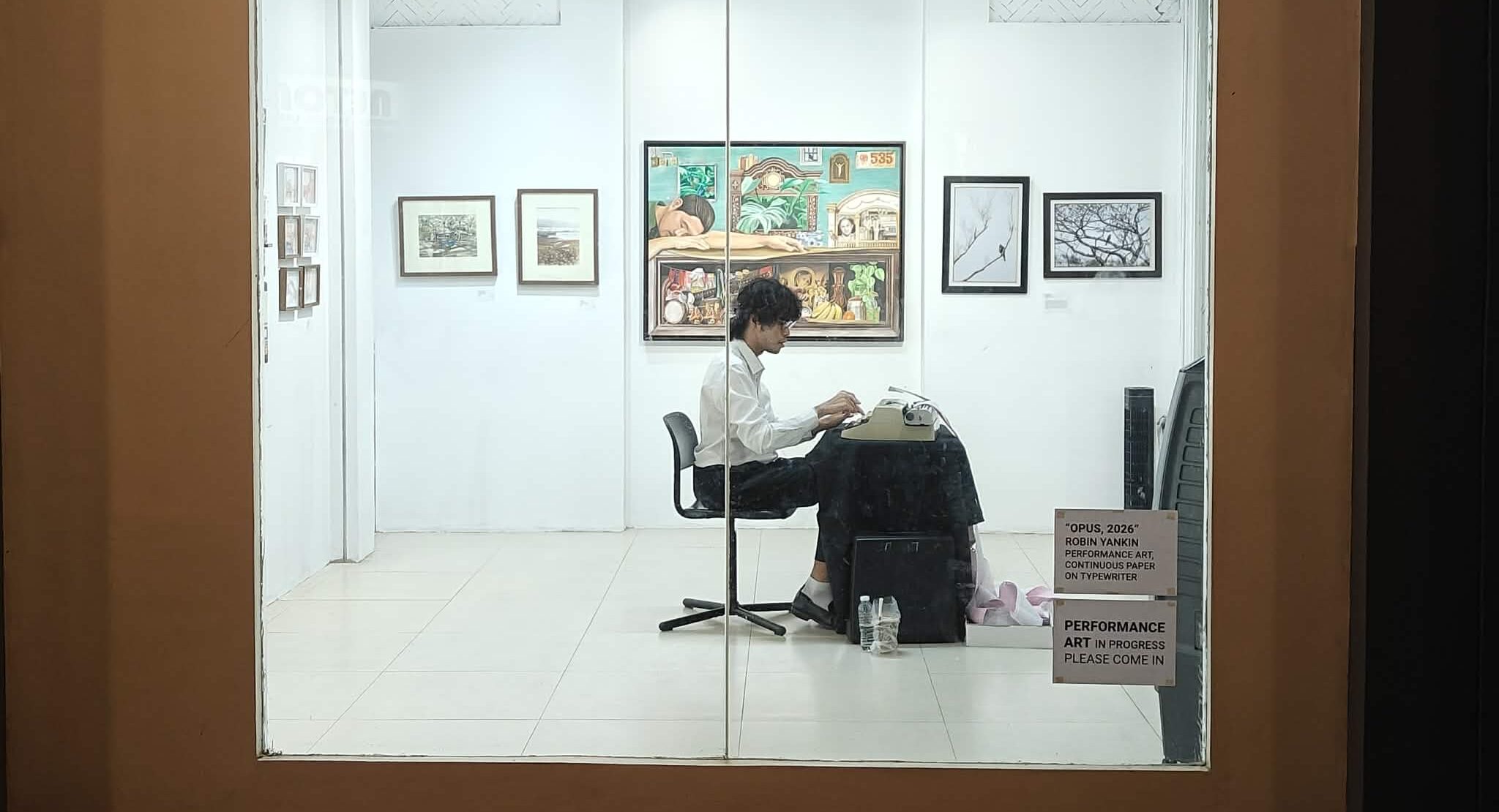
If you frequent literary events in Iloilo, you have likely spotted Robin Yankin and his trusty typewriter, offering fairgoers the unique experience of becoming the subject of a literary work of art—right in the middle of a random afternoon errand or a casual meetup with friends.
Accompanied by fellow writers from their collective, Ambahan, Yankin began creating on-the-spot poetry and flash fiction, often under the shade of the Molo Mansion’s mango trees or at various local pop-ups. It was in one of these weekend fairs that I approached him and asked if he had ever considered expanding this practice into a performance piece for the public to watch inside an art gallery. With his characteristic enthusiasm, he replied that he already had a concept in mind. Later that night, he emailed us an artist statement for a piece titled Opus.
On June 23, 2026, we set up a desk and table at Thrive Art Gallery, and Yankin began typing from 2:00 pm to 7:00 pm. Gallery visitors came and went, occasionally stopping by to read the exhibition notes, take pictures of the author, and, on two occasions, stand close to his typewriter to attempt small talk. Yankin’s peers also started arriving later in the afternoon, including his college literature professor. We also set up a Facebook Live stream where curious people asked questions and enthusiastically cheered him on. By the end of the performance, Yankin finished a short story.
Yankin, who began writing fiction at 17, is the author of two zines: Intermezzo (published by 8Letters) and the self-published Another History of Ourselves. He also penned the novella Almost Blue (8Letters). His writings have appeared in Busay, Sinuman Magazine, Likhaan, UPV Kamaragtas Newsletter, Hablon Newsletter, and UPV Literati. Under the pseudonym Toshiro Hiroshi, he has self-published the novels 9-5 and Conversations with a Rat—both of which were nominated for the Filipino Reader’s Choice Awards—as well as the collection Absolutely on the Pandemic. Through his consistency and dedication, Yankin has firmly established himself as one of the most promising young writers in Iloilo City.
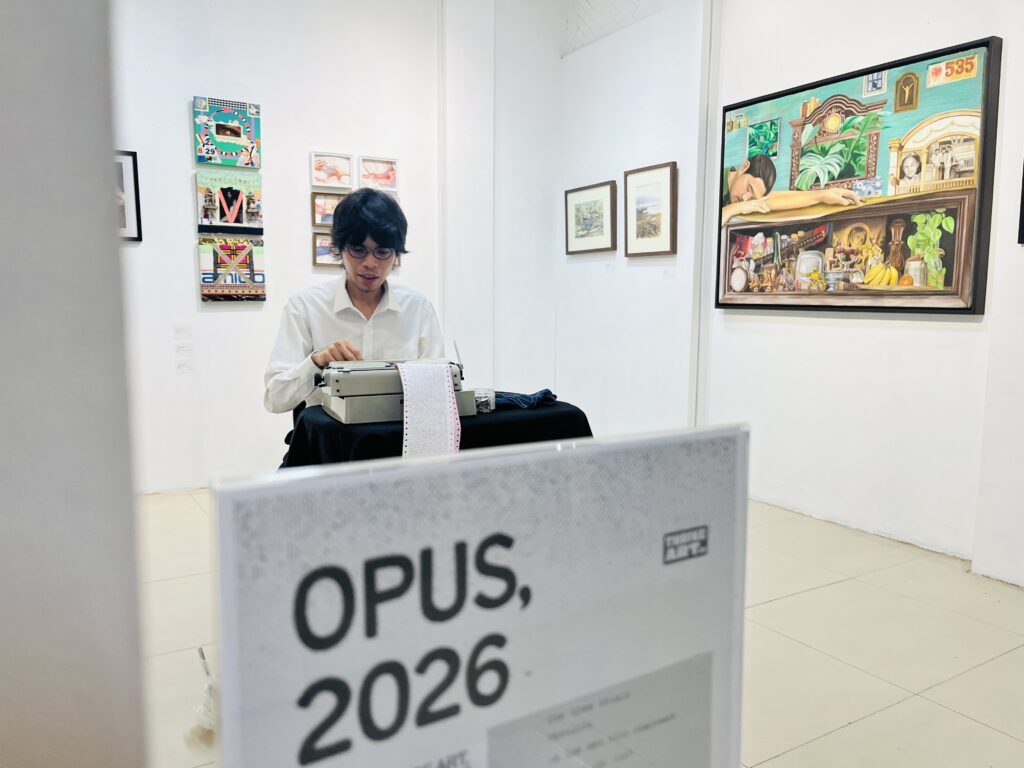
What was running in your mind during the five-hour duration of the performance?
I had only, at that moment, the story in my mind, still liquid, still suspended in mental space, waiting to take shape. Even as my periphery caught the people who came by and left after observing (and despite only two major interruptions), I had not lost the flow of the narrative I had set out to write. (Well, that and constant thoughts of having to go to the bathroom to relieve myself towards the last two hours.)
What was the biggest challenge of doing a durational performance art?
From a physiological perspective, stretching the limits of my body. I had not gone for that long without stretching my back, without answering nature’s call. Internal alarm bells rang throughout the five hours I sat in that chair before my typewriter, but in committing to the piece, I persisted amidst biological programming. By the end of the performance, my body had only begun to process what had happened to it and what it had endured and I felt the fatigue immediately (although, after about three to four hours, I was back to normal). Mentally, however, it was not as exhausting as I thought. It was refreshing, even. I would even go so far as to say that after the whole thing, it was as if I had released a mental constipation that had long since languished internally.
How did you prepare for the performance?
It was all a matter of technique and methods of consumption. I figured since I was to write an uninterrupted story for five hours, I wanted for the piece to embody an manic/hysterical urgency, which was why I decided that it had to be told in a single sentence that looped back into itself like a Mobius strip (inspired, of course, by James Joyce’s Finnegans Wake, with flourishes here and there of László Krasznahorkai, Jose Saramago, Lucy Ellmann, William Gaddis, and William T. Vollmann).
As for consumption, I found my ideas by way of reading, recalling what I have read about, dissassociating/staring blankly into space in hopes of achieving those rare kinds of visions one might experience at the absolute height of boredom, letting my mind wander as I walk to and from work, listening to music (Pink Floyd, Bob Dylan and Japanese citypop most especially), and classic doomscrolling.
Do you think that performance art should be explored more by writers?
Absolutely. I believe many writers should be open to it. This intersection of art and literature I find to be full of interesting material and creative potential that has yet to fully take off, locally and internationally. One example that comes to mind of this intersection at work is Joshua Cohen (Pulitzer Prize-winning author of The Netanyahus), who once live-streamed a novel he was working on called PCKWCK (with occasional notes, revisions, suggestions, and interactions from his audience via chat) for over five days in 2015.
Could you share a bit about what you wrote during the performance?
In essence, the story is about the artist existing in late-stage capitalism. This character I made enters the BPO industry, intending to quit after a year to pursue his passions in writing. However, they find themselves preoccupied with work, and seven years go by, which the character regrets. And then something tragic happens to him that alters his current circumstances, after which he reflects on his personal history by way of an epiphany while staring at the ceiling and time-travelling horses (yes, you read that right). As much as I want to explain the story in full, I will have to stop right here.
To give our readers a little history of Robin Yankin, how did you get into writing?
I remember writing an odd novella with occasional drawings inside a Diary of A Wimpy Kid: Do-It-Yourself book when I was in Grade Five. Even a flash fiction loosely based on Stanislav Petrov I once wrote in between the Regional Schools Press Conference (RSPC) in Grade Eight. But it was not until I entered Grade 12 in senior high that I considered a serious career in fiction.
As Haruki Murakami had an epiphany after watching the Yakult Swallows play at Jingu Stadium in 1978, I too had an earth-shattering epiphany after hearing Mariya Takeuchi’s “Plastic Love” in 2019 the soonest I found it in my YouTube recommendations. Since then, I have published six works of fiction (two novels, two zines, a short story collection, and a novella). As for how I came to embrace the typewriter, I credit my time at the University of the Philippines Visayas in 2023, when I suggested to UPV Literati that I try to write poems on the spot, which turned out to be a riotous success that I brought it outside the university to the public via the Iloilo Mega Book Fair (IMBF).
In your artist statement, you mentioned that AI won’t be able to replace human creativity, how has AI impacted your work as a writer?
As I watch more and more people outsource their hopes, dreams, decisions, inspirations, and other general aspects of life to the glorified Magic 8-Ball that is AI, I still choose to see past the cynicism as I believe that AI could never truly replace writers. AI could never write from the soul because it never had a soul to begin with, nor could it write coherently because it draws from scattered pieces of information that do not connect in any way. That is how people know what is and what is not AI. Sometimes I am afraid of its potential, but I believe that as long as real people continue to express themselves—as long as they continue to sing, dance, paint, write, and publish—we still have hope.
You also alluded to writing as a practice that requires labor, what is it like being a full-time writer, especially in Ilolilo?
All I could say is that I had made the right decision. When I recently left corporate, many people in my circle have expressed concerns about how I might fare after my resignation, but so far, the reception has been quite unexpected and humbling. Sure, there were slow days (and some even had the gall to suggest that maybe we used AI), but so far, I and my other friends in Ambahan made it work (and somehow, I was doing even better than when I was stranded in corporate).
I lived for the random encounters; the stories people shared with me as they gave their prompts; the whole breadth and spectrum of the human experience I summoned as I typed on precut board paper; the moments they received their poems and read them aloud or in silence; the smiles, the laughter, the tears they shed as they read their poems. At the end of every day, I find myself waiting for 12:00 pm the following day to do the same thing over and over again but different. No two days are ever truly the same when you write full-time. Ideas may be recycled, but it all depends on how you treat and approach various angles of those ideas to arrive at any work that you could confidently claim is yours. That was why, as the performance concluded, when I was asked, “After all of that, would you still like to be a writer?”, I, without hesitation, said yes.