
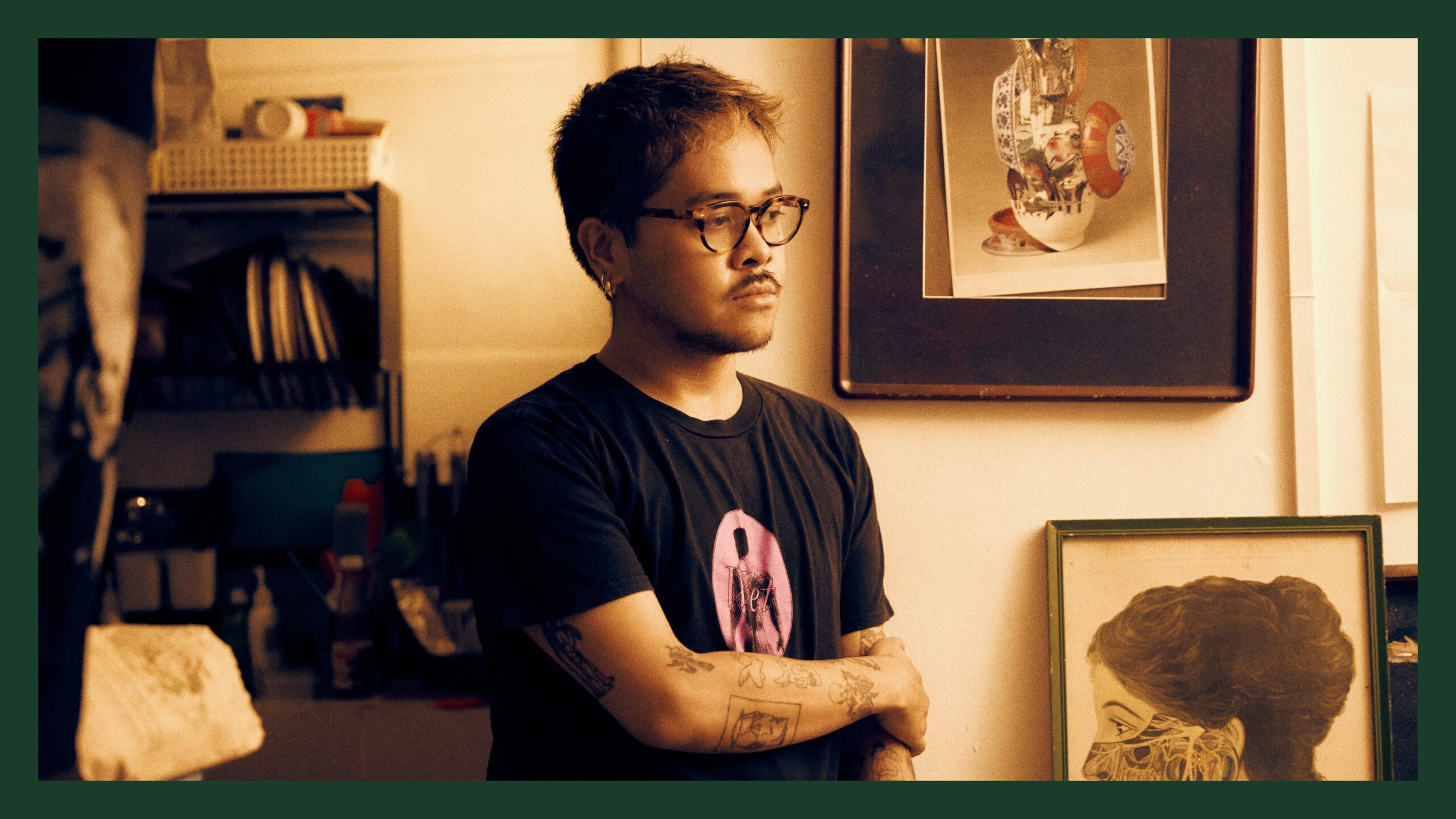
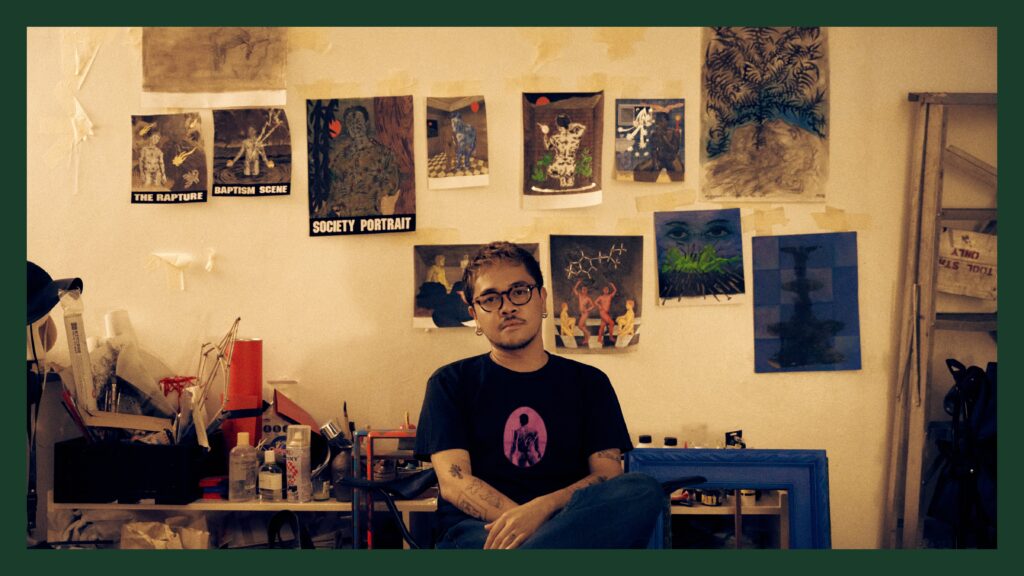
Weeks before the show’s opening, I visited Ginoe at their home studio to talk about their exhibit, Tropa/Trope. Ginoe and I have been friends for a few years now, and I’ve visited their apartment before on the way to a rave. I sat on the couch in Ginoe’s living room, which doubles as their studio. On the other side of the room was a blank wall with leftover bits of masking tape. Ginoe would sometimes post photos of this wall on their Instagram, with sketches and references taped onto it to guide their art production. Ginoe was just starting work for Tropa/Trope, so the wall was relatively clean. The only thing taped onto it was a small slip of paper that said “participation in the arts warrants a tolerance to unruly behavior.”
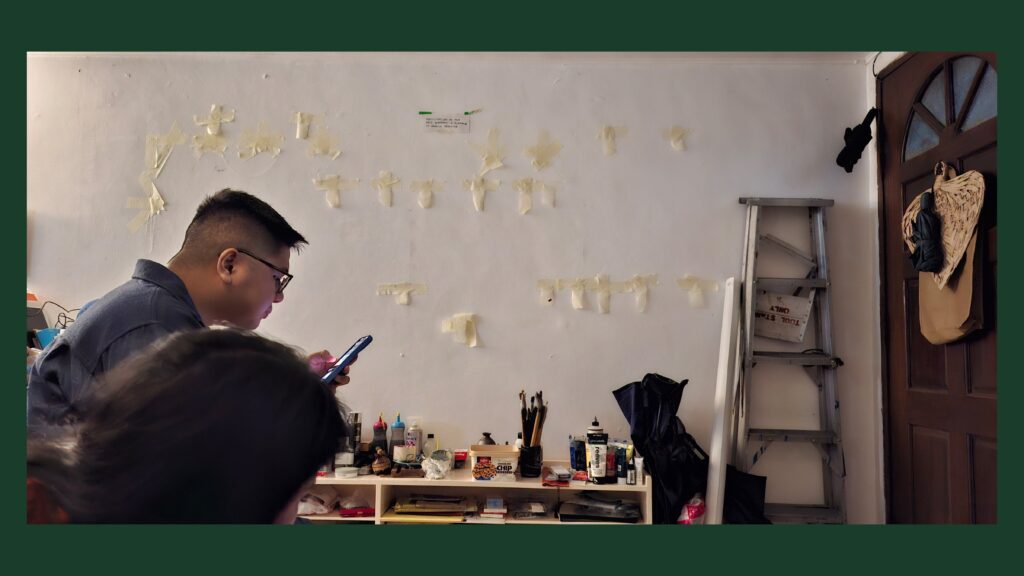
Ginoe worked in front of me as we talked. There was a stack of watercolor paper on the table rendered in different ways to simulate manila paper and the texture on images when they’re photocopied. Leaning on the partition separating the workspace from the kitchen were around twenty frames of different sizes. Ginoe explained that they’ve been buying frames slowly from Facebook Marketplace every payday. The production cost for Tropa/Trope was entirely self-funded, but they were quick to add that they don’t feel the pressure to earn that money back right away. They see the production of art as something valuable in itself, which is an outlook they’re able to maintain by balancing their art practice with a day job at a PR firm.
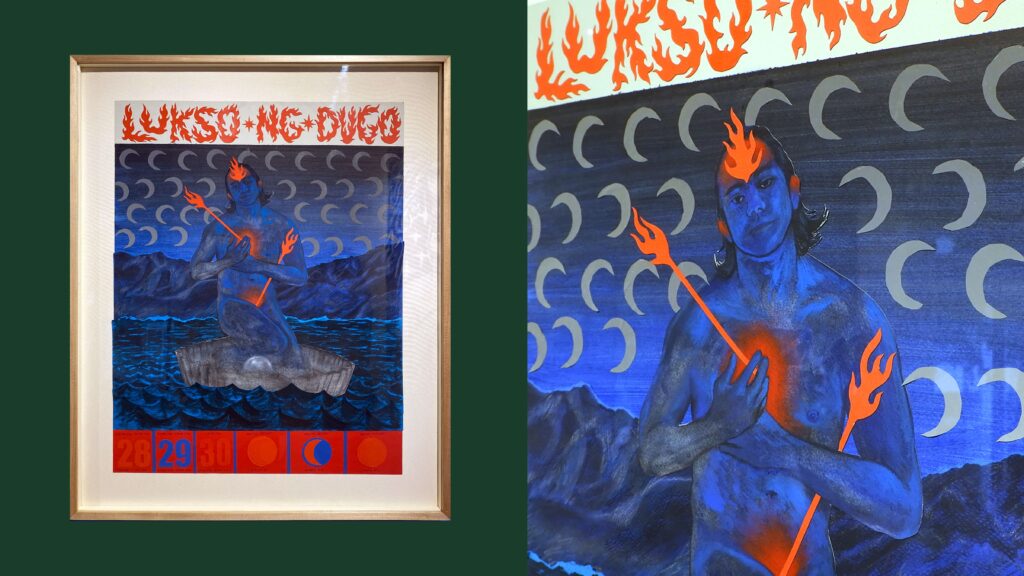
They handed me a small notebook with the show’s title on the cover written in black marker. Tropa/Trope was going to be their first solo show in three years, depicting their friends—their tropa—through archetypes and recurring images from across art history. The concept, they explained, emanated from Lukso Ng Dugo, a work from their solo show Kutob in 2022. Onto paper, they assembled illustrations and cut-outs, first rendered or shaped on separate media. There, they depict their then muse, Kien, in a pose taken from The Pearl, a nude painting by William-Adolphe Bouguereau. Around the subject are elements referencing the tarot card The Moon, and above their head is the title in a fiery red font indicating a kind of fated kinship with Ginoe.
Tropa/Trope expands this, using it as a template to depict not a singular subject, but their many friends, me included. At the start of the year, we were each invited by Ginoe and sent a slide deck detailing the collaboration: they would first suggest an image from art history based on their knowledge of our lives. They would use this as a springboard to ideate a new work while constantly consulting each subject. Then, once we were satisfied with the composition and concept, we’d self-shoot reference photos for Ginoe to illustrate.
The Thinker
The trope Ginoe suggested for me was Rodin’s The Thinker, which both flattered and embarrassed me given the image’s philosophical connotations. Ginoe drew from one of our conversations earlier this year, where I told them about my plans to resign from my corporate job, and my intentions to return to school to study art. One of their initial ideas was to combine The Thinker with Juan Tamad, as a way to question notions of idleness, wherein it is valorized in the former, and admonished in the latter. However, the composition we eventually settled on was of me in The Thinker’s pose, while smoking a cigarette on the toilet. The image came to Ginoe while smoking on their own toilet, before excitedly messaging me with the idea. Ginoe articulated the idea as a subversion of The Thinker’s original conception as part of The Gates of Hell, which depicts a scene from Dante’s Divine Comedy. The Thinker is perched atop the gate, carrying the weight of the world, pondering morality and divine judgement. In contrast, the restroom is mundane, grounding thought as an everyday occurrence, and framing the germination of ideas as something that is cathartic and relieving. Like a shower after a long day, like the kick of nicotine after a few puffs from a cigarette, like taking a shit.
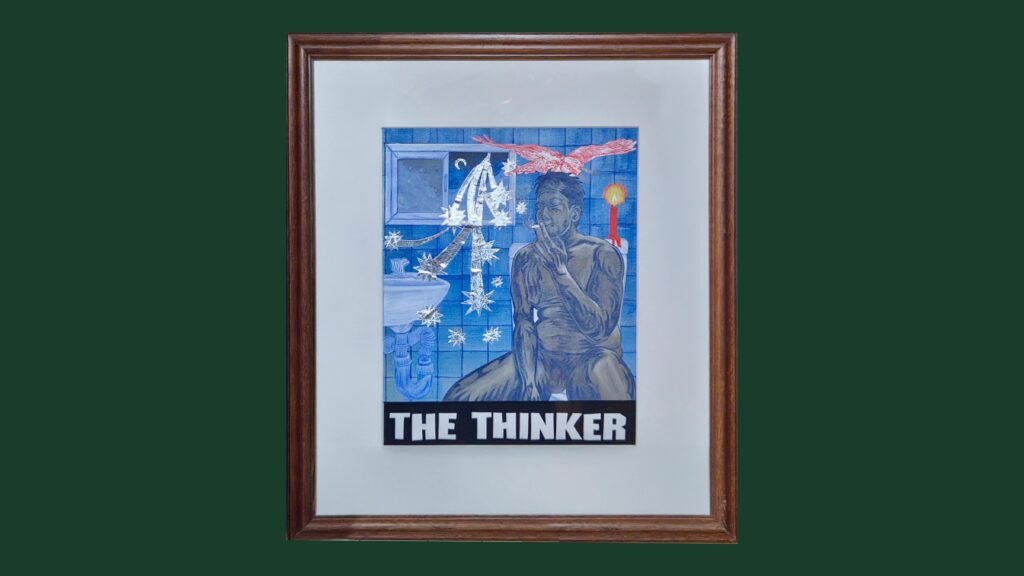
While it wasn’t part of the process Ginoe laid out, I wrote a few paragraphs to respond to their idea. I wanted to give them more context from which they could take cues from, while creating a sort of dialogue between Ginoe’s art and my own medium. Back in college, smoking was my way of regulating my then undiagnosed ADHD. When the pandemic hit, I moved back home. My family members didn’t know about my habit so I smoked in the bathroom to hide it from them. Because everyone was forced to stay inside, the lines between personal and shared space blurred. Cigarettes then became a coping mechanism for me to feel like I had agency and control. Until now there are black marks on the window sill where I used to kill my cigarettes.
I sent the text along with the reference photos to Ginoe. My nudity didn’t bother me at the time, but I would reckon with it later on as the exhibit approached. Throughout their production, Ginoe would send me updates on the work, explaining the little details they added. I saw my likeness in the work, but I was also puzzled by the experience, having not been the subject of such art before. I feel that I am stating the obvious, but I became extra cognizant of the fact that the image was not entirely me, but a visualization of Ginoe’s perception of me. In a way, I felt that my likeness was subsumed by the work, becoming but one element of a larger image.
Tropa/Trope
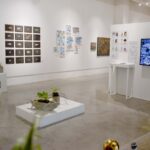
A day before Tropa/Trope’s opening, I met Ginoe and their collective, Sachet Projects, during their ingress at Everything’s Fine. When I arrived, they had just finished hanging works along the bookstore’s exhibit wall, which was painted with figures of palm trees in manila paper yellow. There were sixteen works in total, depicting nude bodies that belong to subjects of different gender identities, but are all assigned male at birth. The shadows on each body are rendered very graphic, calling back to the heavy inks of cartoonist Charles Burns, but more alien and jagged. They resemble cybersigilism tattoos, which, like Ginoe’s art, clash together contradictory aesthetics, simultaneously ancient and futuristic; gothic, but digital.
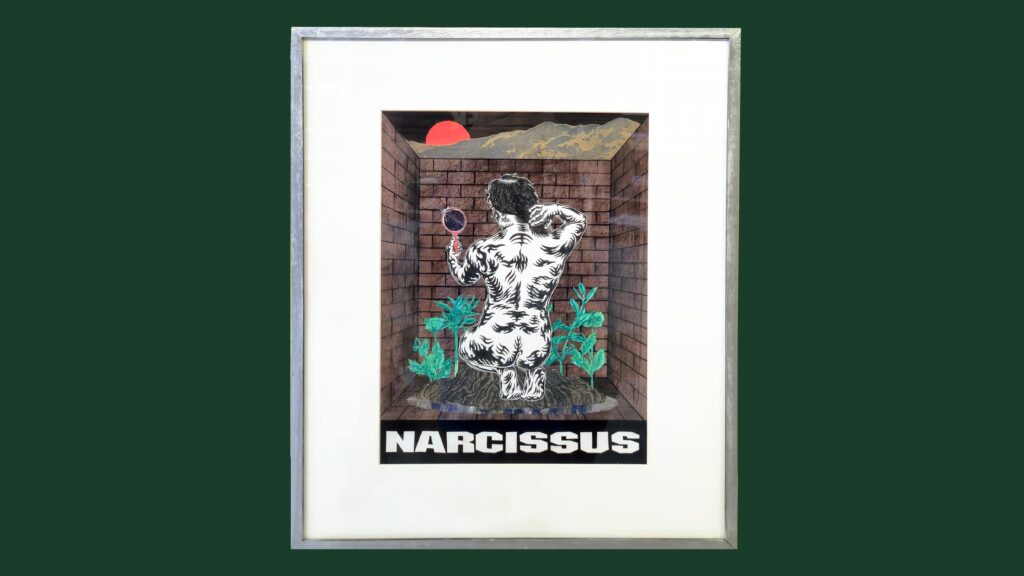
In contrast to Ginoe’s previous show Kutob, a dark undercurrent pervades the works in Tropa/Trope. The vibrant and romantic blue that I have come to associate with their work receded to make way for darker tones—of green, brown, and gray, the colors of rot, mud, and ash. Across several works, Ginoe depicts the sun in an ominous shade of red, most effective in Society Portrait, where it peeks behind a bamboo shoot, appearing radioactive within an image of mostly cool and muted colors. There is also the repeated use of corners to create spaces that feel enclosed, cutting off their subjects from the outside, like in Curio or Narcissus. In the latter, Narcissus is turned away from the viewer, looking at themself through a hand mirror. They are enclosed by brick walls, seemingly trapped in a corridor, but there is no urgency to escape.
The Rapture and Baptism Scene depicts their subjects in the middle of catastrophe. The former shows an erupting volcano and comets plummeting to the earth, with the subject resigned to their fate, staring blankly into the distance. The latter is more timely, depicting its subject in the middle of a storm. They are knee-deep in flood as lightning strikes their chest. In most of Ginoe’s works, the images function as metaphors for the lifeworlds of their subjects. However in these two works, they also signify reality as disaster has become all too familiar in our day-to-day lives. Now more than ever, we are aware of the destruction that comes in the wake of flood, the diseases that water can carry, and the broken system that leaves us prone and vulnerable.
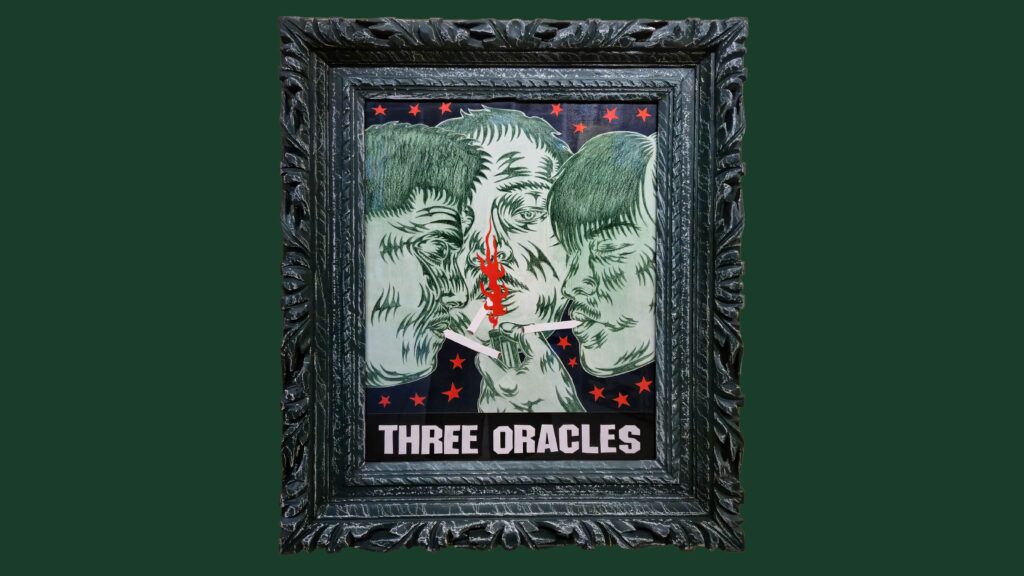
Ginoe references existing archetypes that permeate our collective canon of images. They call back to Greek myth in Narcissus and Three Oracles, to religious imagery in Oculus Dei and Agnus Dei, and to figurative traditions like in Society Portrait, and Recuerdo de Buhay–a play on recuerdo de patay. These carry meanings that have sedimented over time, onto which Ginoe superimposes the narratives of their subjects. This act is like poisoning a well, infecting images that were once enshrined in museums and churches, with the burdens, wounds, shortcomings and heartbreaks, but also the intimacies and vicissitudes of their subjects. The once familiar images mutate into omens for the world we currently live in, surfacing a burgeoning anxiety that speaks not only of individual experience, but of how queer lives contend with the worsening crises of today.
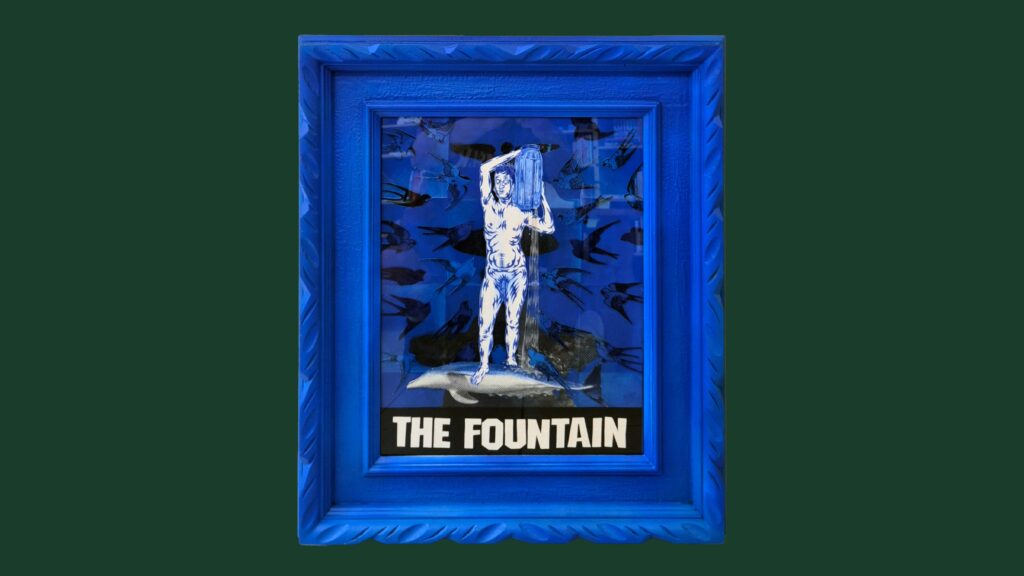
The grim imagery is cut through by The Fountain in its bright blue frame. It depicts the subject as Aquarius, the water-bearer, carrying a gallon of water in an Aquabest container. Water flows out from the spout, down to the beak of a single bird near the subject’s feet. The rest of the frame is filled with other birds flying towards the subject, who upon closer inspection is superimposed onto an image of a fountain.This work is like a candle in a dark room in relation to many of the other works in the exhibit. Blue, Ginoe explained, is a color they use to show affection, here pouring out of the image in abundance.
The color bleeds out onto other works like Lounging Wound Man, and finally The Thinker. When I arrived at the ingress, I realized I was nervous to see my likeness on the wall. I thought about the nudity shared by all of the exhibit’s subjects, which I initially chalked up to the concept. After all, it is a kind of figuration that occurs throughout art history, which the exhibit explicitly contends with. I recalled Tenderness, a show by JL Javier that was exhibited in the same space. It sought to explore its titular condition in masculine bodies through photos of men in different states of undress. I was also reminded of Deej Amago, one of Ginoe’s contemporaries, whose art hews closer to the realm of erotica. His subjects are depicted bound by ropes, a common trope in Japanese Bara art, or in the act of sex itself. Several other artists that came to mind, whose depictions of male bodies are framed through notions of vulnerability or intimacy. However, I felt that these kinds of works towed the line between meaningful exploration, and replicating the more dominant male gaze onto queer bodies. How then I wondered was Ginoe’s depiction of me, and the exhibit’s other subjects, any different?
Self Portrait
Beyond the tropes nested in each work, Tropa/Trope grapples with this kind of nude figuration that is common within what is often haphazardly pigeonholed as queer art. I wouldn’t say that Ginoe is able to completely subvert or evade this type of representation—nor do I believe that this is what the exhibit sets out to do—but I think much can be gleaned by thinking about them with respect to Ginoe’s self-portraits. Their body of work is replete with self-portraits, but they are missing from Tropa/Trope. Save for three oracles, where one of the faces is Ginoe’s, there was no image where they singularly depicted themself.
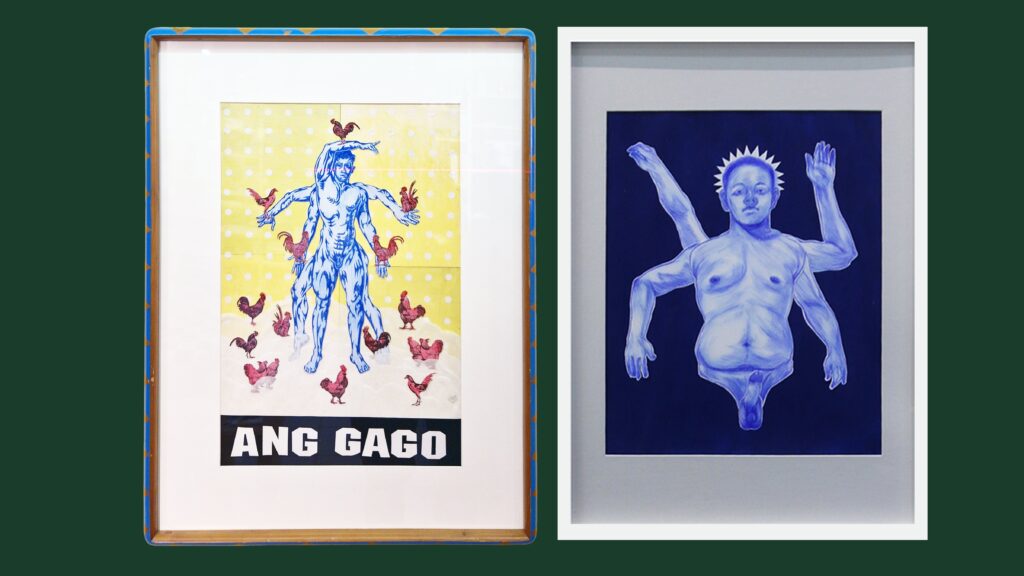
Right: Alaplaag. 12 x 15 in. Wax pastel and acrylic on paper. 2019.
During the exhibit, Ginoe displayed their Codigo, a compendium of the images that the show calls back to. There, the work Ang Gago is shown to reference Alaplaag, a self-portrait by Ginoe from 2019. In both works, the subjects are nude and rendered in bright blue, with extra arms that extend from their backs. The latter depicts Ginoe without legs, an erect member, and a jagged halo radiating from their head. The former builds upon this, depicting its subject as da Vinci’s Vitruvian Man, and adding the title’s text, which evokes both the tarot and Brenda Fajardo. Here the thread between their self-portraits and Tropa/Trope is clear. While stemming from Lukso ng Dugo, the figuration used across the exhibit is ultimately rooted in Ginoe’s experiments depicting their own queer body and image. In the way that there is tension in each work between the trope and subject, there is also tension between subject and Ginoe. Each work is also a self-portrait of the artist, projected onto tropes, and projected onto their friends. There is a reciprocity and reflexivity to the gaze that Ginoe employs, refracting themself across a hall of funhouse mirrors, wherein each mirror is another person.
When I asked Ginoe about the impetus for the exhibit, they explained that it depicts where they are now, having taken their time to settle in Manila after moving from Silay. They’ve nurtured relationships old and new, and started Sachet Projects with their friends. In the past few months I’ve come to understand these relationships as central to their practice, in nourishing their work, but also as part of an impulse to help their friends discover their own craft. I think about my own relationship with Ginoe, who I was first a fan of, before we became friends, and now collaborators. Perhaps my confusion upon seeing The Thinker, comes from it being not only an image of me or my likeness. Embedded into it are the sinews that connect my own individual lifeworld with theirs, which in turn is connected to those of the other subjects. Then, by encoding these connections into art and exhibiting them, Ginoe ultimately bare themself, and the ways they have been transformed by the people around them.
Tropa/Trope ran from Aug 9 to Sept 14 at Everything’s Fine in Makati.
This article was first published as a zine, released at BLTXmas 2025.