
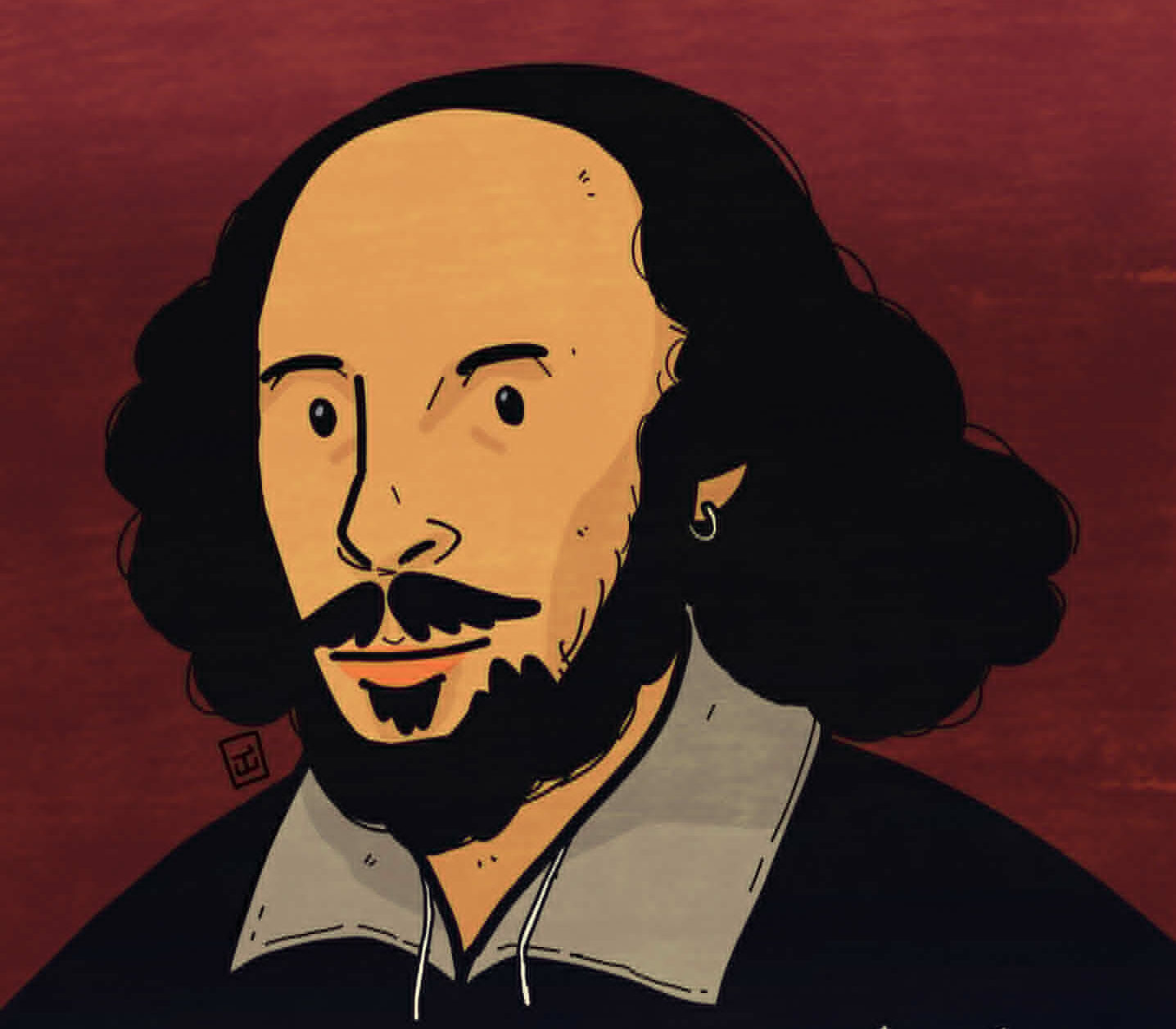
We either loved or loathed the Bard in high school. The plays, the sonnets, the long poems – why bother?
Maybe it was about the way Shakespeare’s works were taught: there were classes where studying the subject matter meant memorizing the titles of the 37 plays, plus a sonnet or two to boot; others put you trembling onstage, sputtering out lines that sounded English, but which we barely comprehended. And then there were those classes that milked human kindness and depth out of his stories and verses: these we truly savored and cherished.
First encounters with the Bard
For some of us in high school, we had to do the overly used and abused balcony scene from Romeo and Juliet, without understanding half of what the characters are talking about. Or the stabbing scene from Julius Caesar, where all the boys were wrapped in blankets, and everyone looked forward to the moment when they can stab the eponymous lead (usually played by the detested Shakespeare geek in the classroom).
My own encounter with the Bard was through a voluminous Kittredge edition of his complete works, punctuated with pages of photographs of notable performances, featuring the ‘greats’: Laurence Olivier, John Gielgud, Richard Burton, Vivien Leigh, Claire Bloom, Judi Dench, and Maggie Smith, among others. In college, we had to sit through Kenneth Branagh’s film adaptation of Hamlet, performed in full. Sitting through four hours of Branagh delivering Shakespearean dialogue either resulted in hankering for the next play or in forever spurning any hint of rhymed drama. I ended up with the former.
Still, there is always a degree of intimidation and confusion when approaching Shakespeare in the classroom, more so in a Filipino classroom. Of what meaning and relevance are fairies, princes, knights, bloodthirsty Roman senators, and petulant shrews to high school students who stifle in the heat and illiteracy of a poverty-ridden country? All the reasons offered are old, if not defunct and detached – that Shakespeare is the quintessential English playwright, the great standard for the language; these and whatever other linguistic or literary persuasions and inanities our teachers vibrantly presented to sell his works. Consequently, and to our detriment, we mythologize the writer more than the writing. By the time we get into his plays and poems, we tremble at his name even as we sit tense and terrified of the forthcoming ‘thees’, ‘thous’, and ‘thines’.
Then again, the works were not meant to be read (his sonnets and long poems included) – this perhaps might be the first pitfall of our pedagogy. Shakespeare’s works were essentially meant to be performed, and as such, witnessed and understood best from a theater audience’s point of view or from a performer’s lived experience. His poems and plays demand a place – his wooden ‘O – and it is with autobiographical insight that he refers to ‘all the world [as] a stage, and all men and women merely players.’
A ‘different sort’ of English… but we get his point
Let us not sugarcoat the grim fact that Shakespeare’s English is not ‘our’ English. We have to come to terms with the fact that Elizabethan syntax, semantics, and figurative lingo are simply not the conventions with which we converse in the language today. But it does make for a good study of the development of the English language. To note, Shakespeare used the contemporary language of Elizabethan London: bawdy and brusque, ornate in formality, and downright filled with idioms and colloquialisms. Overcome these idiosyncrasies, and you slowly begin to sense that he actually makes sense. His grasp of the world – people, relationships,
conflicts, and all the gray areas in between – provided him with a palette that refashioned how humanity is central to narrative.
For all the histrionics of his stories, Shakespeare’s stature may be reduced to the universality of his themes – but even that is a gross simplification of the writer and his literature. Remove the tinge of groveling to the powers-that-be during his time or the florid tendencies of his language, and you encounter the spectrum and range of humanity in his characters. Perhaps nowhere else in the canon of English literature would we ever find that depth and catholicity of understanding the human persona, from the irredeemably born-evil to the absurdly jovial bonhomme.
Whether we surmise the Bard as a deeply observant wordsmith of human nature or merely a poetic wit of his times, there is a timeless relevance to his characters, those that capture the incessant struggle of man against the forces of his psyche and his world, consciously or otherwise (Sinha 2016, 151). As such, we recognize a timeless eloquence in the railing and ranting, in the banter and badinage. Shakespeare’s kings are troubled personas, weighed down and crushed by crown, cruelty, and the poisonous appeal of power. His lovers are emotionally punished for their attachments, yet find sweet sorrow in the pursuit of love. Macbeth blessing
and cursing his fate is an examination of our propensity for evil. We are torn in moral ambivalence by what is laid before us in the repartee of Marc Antony and Brutus. Caliban is beyond redemption from malevolence, as Sir John Falstaff is beyond redemption from the flagon and the comic foibles of life. Hamlet is every angsty teenager at the crossroads, as Othello is every jealous lover: both eventually sink in remorseful regrets – and who does not use the tragedy of the star-crossed lovers as the benchmark of a ‘great’ romance?
Shakespeare transcendent
While Shakespeare’s works are the offspring of his times, their subjects are not intransigent to shifting modes and trends. There was a Julius Caesar in fascist uniforms, a gang war Romeo and Juliet danced as a Broadway show, a leonine Hamlet set in a Disneyfied African savannah, a politicized Titus Andronicus, mirroring Iloilo City’s political scene, Taylor Swift’s sappy soliloquy about a certain love story in fair Verona – and how many more ballets, operas, musicals, music and songs, film adaptations, novelized spin-offs, parodies, Wattpad obscura, and dramatic extrapolations have nitpicked the plays to their barest bones?
Translations of his works further break through the confines of his language. Eminent Shakespeare scholar Judy Ick underlines the movements and shifts of the literature when subjected to translation. For instance, Tagalog translations by National Artist Rolando Tinio reframed Shakespeare’s narratives through a postcolonial lens, which pulls out the translated works from mere mimicry and veneration to a discursive platform of resistance and response to colonization. This may have surfaced from the desire to appeal to a more culturally aware and academic theater audience (Ick 2014, 15).
Yet the translation of text, especially for the dramatic stage, also presupposes a ‘translation of culture’ in a contextualization that ideally recognizes and maintains the original in performance (Lind 2018, 221). It follows then that while Tinio situated Shakespeare’s text in the milieu of the Filipino language, the nuances of Shakespeare – the phantasmagoric, magical, romantic, or royal aspects of his narratives – are preserved onstage. Who said we cannot have a diwata for a midsummer night fantasy or the Scottish play replete with mangkukulam and Filipino habiliments?
After Shakespeare, one might argue that the bank of literary archetypes has been pushed and exhausted to its extremes: no other canon of literature, in drama or prose, would ever explore these themes again as comprehensively as his plays. Conversely, we can challenge the premise by arguing that Shakespeare himself did not necessarily bother to create new narratives, but rather use or restructure existing materials: his Troilus and Cressida was a direct dramatic rewriting of Chaucer’s poetry, the Roman plays were snatched from Plutarch and other classical historians, and did it not bother anyone that Romeo and Juliet seemed like an expanded version of the myth of Pyramus and Thisbe?
But that is the argument of archetype: it is the trite and the cliché, and in insistently presenting themselves again and again in various iterations, they establish the premise that human nature harks back to what it is familiar with: that human nature is immutable becomes the essential lesson of all history. What Shakespeare merely did was to reframe these archetypes in the dramatic form, setting them to the demands and confines of the Elizabethan theatre, without losing touch with what he understood to be agelessly relevant and relatable. In that sense and more, his plays are indeed the thing wherein he’ll catch the consciences of all.
So what is in store for the Bard? Perchance a continuation – and cultivation – of that love-hate tryst. No, Shakespeare would not mind being disparaged at all. Amid the sprouting of new stories and literary forms, we still find a certain certitude that his works, for all their anachronisms, will find their own spotlight. Back in the classroom, perhaps we can let the young ones recite the sonnets out loud or watch the plays as they are, in whichever interpretation. (Leonardo DiCaprio and Claire Danes were divine in Baz Luhrmann’s 1996 Romeo + Juliet). Let them stumble upon this undiscovered country, draw them into the tryst. Our classes about
Shakespeare and his works need not be ancient grudge-breaking to new mutiny.
References:
Ick, Judy Celine. “The Undiscovered Country: Shakespeare In Philippine Literatures.” Kritika
Kultura 21/22 (2013/2014): 1-25.
Lind, Paula Baldwin. “Translating Shakespeare, Translating Culture: Text, Paratext, and the
Challenges of Recreating Cultural Meanings in Text and on Stage.” Studia Litteraria Universitatis
Iagellonicae Cracoviensis 13 (2018): 219–235.
Sinha, Gopal. “An Objective Evaluation of Shakespeare’s Universal Appeal.” International
Journal of Recent Research in Social Sciences and Humanities 3,2 (April–June 2016): 151-154.
Featured artwork by Alden Sorongon