

Why do you write about art? And how do you do it? Students and acquaintances quiz me about this relentlessly. The caustic response would be: “Eh, why not? There’s something to write about.” Still, the inquiry is valid. One does not simply sit down and decide to write something as eclectically amorphous as Art. Yes, it is quintessential to our nature to pursue and appreciate the Beautiful. John Keats eloquently captured this affinity towards things aesthetic with the last lines of his Ode on a Grecian Urn:
“Beauty is truth, truth beauty,—that is all
Ye know on earth, and all ye need to know.”
Conversely, one rarely takes time to read what is written about what is aesthetic. Art writing and criticism are usually relegated as opinion: one finds the art reviews and articles tucked between society news, as if part and parcel of novelty and trends. So why bother to write about art? What’s the motivation behind this?
For context, I teach in one of the private schools here in the city. When senior high opened, the administration plucked me from junior high to teach Contemporary Philippine Arts to Grade 12 students. I received a nebulously idealistic two-page curriculum guide as reference: no art recommendations, no suggested references, just sparse columns of competencies left to the interpretation of the enterprising teacher.
So how does one implement the course? The easy way out is to make students draw something, whether they like it or not, then assign a numerical grade – rubrics included – to the aesthetic activity. “Your art is realist portraiture, you get a 90; yours is also a portrait, but distractedly cubist, you get an 85. Oh, it’s abstract? That’s so easy to do! You get a 79.” Make that make sense.
Alternatively, we can always converse about art in class: explore its finer points, retrace roots and contexts, describe nuances, discuss implications and relevance to our culture and national identity, and even zoom out to how art operates in contemporary society. I realized that this was a more viable option. Here, every student can dabble in art, (self-proclaimed) artist or not – the course has to be about appreciation and criticism. To talk and write about art is to be involved in the artworld.
Inevitably, I asked them to write critiques and essays about art. Of course, I did not expect compositions with enough panache and technical flair to get published in The New Yorker. (I sincerely hope that one of them will eventually.) All the same, the requirement got them thinking and conversing about the subject. It goes without saying that most of the motivation with which I write these reviews and essays stemmed out of this exercise. In an interview with the late Leoncio P. Deriada, he bluntly told me never to give a student a task which I myself as a teacher cannot accomplish. If I am to demand art writing from my students as evidence of appreciation, should I, the exacting teacher, not write as well?
Still, appreciation is a difficult response and ‘skill’ to measure – and I have no qualms telling my students that. For all the rubrics that one may develop to provide some gauge for appreciation, these do not translate to or represent the real value of the artwork: the priceless effort, the spiritual turmoil, the sublime experience, the dredging of the heart-wells and the soul-strife of the artist. Rubrics may provide a numeric score on paper, but think of the absurd hilarity of scoring how one perceives an Amorsolo landscape, a Giacometti statue, or a Bashō haiku. My piano teacher, the late Marciano Guanco, never insisted on verbose critiques either. The spontaneous sigh of appreciation or the sharply worded growl of derision during a recital or a film screening were enough for him: these were sharp, succinct, straightforward, and most importantly, sincere.
But a sigh of euphoria or a grunt of disdain can hardly be recorded for posterity. Something set in a medium that can be revisited time and again – something linguistic perhaps – would be more preservative of whatever insights gleaned from the artistic experience. In his preface for The Picture of Dorian Gray, Oscar Wilde points out that the main task of the critic is “to translate into another manner or a new material his impression of beautiful things.”
In 1967, art educator Edmund Burke Feldman proposed a model of art criticism, one that still makes for a viable reference whether as structure for writing a critique or simply as guideposts in discussing art. In his book Art as Image and Idea, Feldman’s approach identified four aspects of criticism: description, analysis, interpretation, and evaluation – though not necessarily in that order.
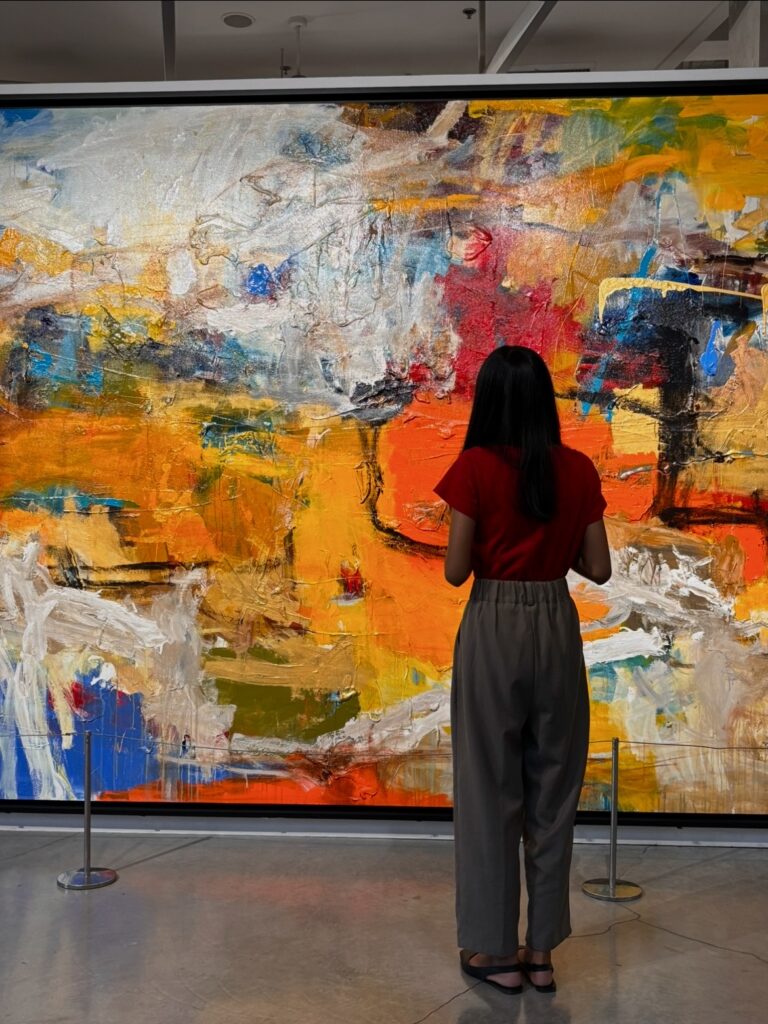
The usual experience of viewers when they enter a museum begins with mere perusal. No one goes in front of an artwork by Rock Drilon, and then immediately asks introspectively what those lines, doodles, abstractions, and combinations of colors mean. Meaning-making proceeds from visual intake. Enter the gallery, look around, soak in the geometries, colors, and representations, look around some more, soak in the plethora of imagery to the point where one is sometimes visually overwhelmed. (True story: a student of mine had to sit down after loitering around in one of the galleries at ILOMOCA to let everything ‘simmer down’.)
Of matters sensory, definitions begin with descriptions. We can readily or otherwise say that birdsong and windy soughing are pleasant to the ears, that the casserole is savory to the taste, that Chanel No.5 is fragrant to our nasal sensibilities – and so it is with Art.
There are some artworks which invite the most elementary descriptions: to provide a vibrant illustration of what are readily perceived by the eye sometimes suffices as a form of criticism. Line, color, hue, shade, and shape present themselves as subjects for exposition and our aesthetic sensibilities find simple pleasure in indulging the eye with their combinations. For instance, if we delve into the canon of modern art, the elements and geometries of Mark Rothko, Kazimir Malevich, Wassily Kandinsky and Piet Mondrian, to name a few, easily catch the viewer’s eye, and while the more perceptive and critical connoisseur will segue into nitpicking meaning from forms and structures, one can be content in filling the eye and soul with what is candidly perceivable.
Then again, there is no shallowness of thought in finding beauty in mere descriptions. On the contrary, it provides us a basic glimpse of what truly makes an artwork appealing: if Beauty is in the eye of the beholder, then it must captivate the viewer’s gaze at first glance.
If we take one step further into a more formalist take on art, we delve into analyzing the artwork. Analysis looks into how elements come together to achieve aesthetic principles, which are, in one way or another, instrumental in providing some order or coherence in the work. As in a literary work, these principles ‘narrate’ the nuances which hold the art together: balance, movement, emphasis, contrast, unity, variety, rhythm, and pattern.
These principles occur and recur incessantly through art forms. We sense a pleasant and calming symmetry and proportion in the linearity of the Parthenon’s architecture. The flow and ebb of Hokusai’s The Great Wave speak of the powerful surge of storm and sea, frozen in an implied motion undiminished by the stark lines of the artwork. The portraits of Kristoffer Brasileño draw the eye towards the human visage, emphasized even as accentuating elements are contrastingly subordinated around facial features. The dreamscapes of Salvador Dali juxtaposes unlikely imagery like visual oxymorons, making the curious viewer question which is imagined and which ought not to be. The many-colored iterations of Andy Warhol’s posters are varied yet still hold on to a single subject repeatedly – and who can escape the persistent rhythm and melodic pattern of Maurice Ravel’s Bolero?
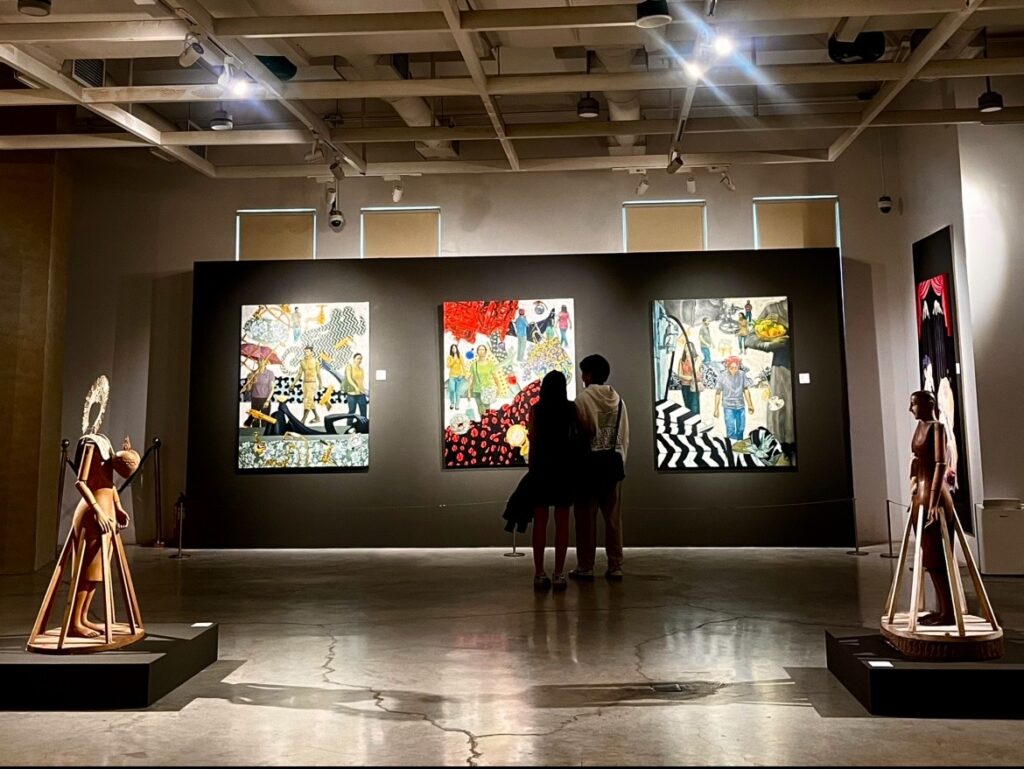
In class, I would ask my students to inscribe lines and shapes on colored copies of artworks. (They eventually detested this.) Look for the geometric references. Determine the horizon line. Mark the lines of perspective pulled towards the vanishing point as visual anchors of the art. Identify the central subject of the work and the supporting elements at the peripheries. There is no expectation from them to become architects; rather, it trains their eyes to look for detail and design.
For the interest of analysis, the artist’s style and technique matter and ought to make sense. Admittedly, the temptation for the critic is to pepper what he writes with jargon – something that I admit I am guilty of on occasions when it cannot be avoided. Chiaroscuro, sfumato, trompe l’eoil, mise-en-scene, pas de deux, allegro, pizzicato, ostinato; the foreign terms are legion – and they sound erudite to the verge of snobbery; hence, it is still left to the discretion of the discerning writer that these are tempered in a manner which does not intimidate the ordinary reader but rather brings them into a much profounder understanding and appreciation of art.

Interpreting art is more layered and subjective. The invitation to the teacher is to accommodate a variety of lenses through which students may find and glean meanings from the artwork. Here, pedantry must confirm the subjectivity of art without losing the objectivity offered by descriptions and analyses. Blue is still blue to the perceiver, yet as to what the blueness in the artwork denotes or insinuates is left to aesthetic sensibilities. Without dispensing with the artist’s own intentions and inspirations, the criticism slants towards the biases of the audience – in interpreting what is visible in the frame, the viewer brings so much more of himself in the artwork than the artist: one finds what one is looking for in the canvas. Small wonder why Oscar Wilde calls criticism a form of autobiography. Whatever political, cultural, archetypal, cultural, spiritual, ideological, or even economic reading of the artwork is deeply influenced by the contexts of the onlooker.
It has been a recurring topic of debate about whose interpretation matters: the artist’s or the audience’s? I decline to answer: that question is the crux of contemporary criticism. The tension in the liminalities and interstices where readings are contested and negotiated between artist and audience manifests the timely significance of the art: if people discuss and debate the work, then it must be worth talking about, regardless from which time period or cultural roots it came from.
At the risk of turning art into anachronisms, openness to sundry interpretations expands appreciation. When we talk of the Renaissance canon – da Vinci, Bernini, Michelangelo, Raphael, and the other names associated with the period – we question who and what decides their works to be considered ‘classical’. Quite removed from the time of Marx, one can still read class and social struggles in Francisco Goya’s El Tres de Mayo or in Eugene Delacroix’s Liberty Leading the People. The somber, stooped portraiture of Jean-François Millet’s The Man with the Hoe holds more political undertones than any propaganda art produced by Nazi Germany or Communist China. Salvador Dali’s works bare themselves to psychoanalytic interpretation, even without scrutinizing the artist’s bohemian lifestyle. The feminist archetypes of Frida Kahlo are powerfully driven with a contemporary Jungian reading of the symbols she used, the familiar objects which surrounded her daily life and sufferings. We can always stand in awe before the stylized distortions of Manansala, Kiukok, and Imao – but don’t you find vestiges of Picasso, Seurat, and Matisse in these?
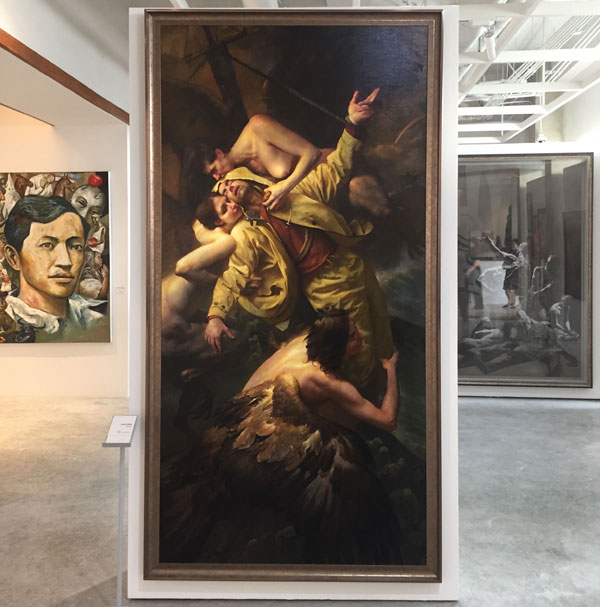
A personal favorite study for interpretation would be Adam Miller’s Odysseus (currently in storage at the Iloilo Museum of Contemporary Art). In the artwork, the eponymous character of ancient myth is transmuted to a modern day configuration replete with contemporary garb. Does the intrepid traveler, clad in a rubber wet-suit amidst stormy waters, grimace in pain or pleasure? The Sirens, clawing at his body and singing to his ears some unwritten melody – what secrets are they telling him to cause him to respond with that fulsome demeanor? What understandings and reflections are put across to the viewer in the juxtaposition of the myth and the modern?
Homer and his classical translators are dead – but the artwork is not. In the canvas, the epic lives again, yet not in the same way when it was recited in ancient Greek centuries ago. The character endures, but only in the manner the artist wishes him to endure and through the audience’s intellectual and sentimental readiness or unwillingness to understand this depiction of him. In Miller’s art, the modern aspires to rescue the myth from cliché obscurity.
After everything has been perused and scrutinized, Feldman caps off criticism with an evaluation. But rarely do I evaluate an artwork – then again, to say that a particular work is “good art” or “bad art” would be more to personal taste, and while I present descriptions, analyses, and possible interpretations of artworks, I am wont to pass judgment. Rather, I prefer to see relevance and significance: connections are established with contemporaneous circumstances, recognizing that images can become social commentaries or statements of protest and advocacy or conglomerations that build up to an intended purpose.
My students would always complain that I ask too many questions which have no clear answers, especially when I conclude a lesson in art appreciation. But a meticulous and balanced evaluation always anchors itself on sharp questions. Who gets to appreciate the artwork – and who gets to price them? How much value would there be in an art student’s fledgling sketch of, say, Vermeer’s Girl With a Pearl Earring, a mere copy of probably an Internet copy of the original artwork? When artists depict the toilsome labor of our farmers and fisherfolk, what agency would these people – the subjects of the artwork – have to be able to experience the art? When artistes push the boundaries of the creation of new iterations of art – say for instance, performance art or hyper-minimalism, how ready is the artworld to receive and appreciate these? In the spirit of art for art’s sake, should the artist be content with applause as response and payment – or is it high time we relegate the romanticized ‘starving artist’ to the confines of the dramatic and operatic stage? At the end of it all, do we buy the artwork – or the signature in the artwork?
Nary a definite answer can be given to any of these queries without opening a can of worms. But they do elevate the art into something else: as historical artifact, as national narrative, as social commentary, as protest slogan, as philosophical treatise, as social experiment, as intellectual theme to reflect worldviews and refract the spirit of the times. If valuing art must go beyond the price tag, then it must entrench its significance in public consciousness and even academic discourse. Hence, the need for art education: it is not enough to put up art in public spaces; one must educate the public on how to appreciate (and maintain!) these as well.
Thus I write about art – mostly descriptions and interpretations but with the occasional snide harangue. In the artworld (and in many other things), there is no such thing as bad publicity: the avant-gardes of the 19th century looked forward to all the foul things written about their modern art in the Parisian tabloids. Now their art hangs at the Louvre, thanks to all those bad reviews: in all appearances, controversy has sown the seeds of appreciation. (In hindsight, who actually remembers the reviewers and critics?) What would be more disturbing is if no one gives a damn about the art. Translation: it’s not even worth a bad review. Still, the intention must not be to pander and kowtow to the popular and the trendy. Rather, it is to understand – and make others understand – from which maelstroms of which heart-well the Art emerged from, to respect the soul-strife that went into its making.